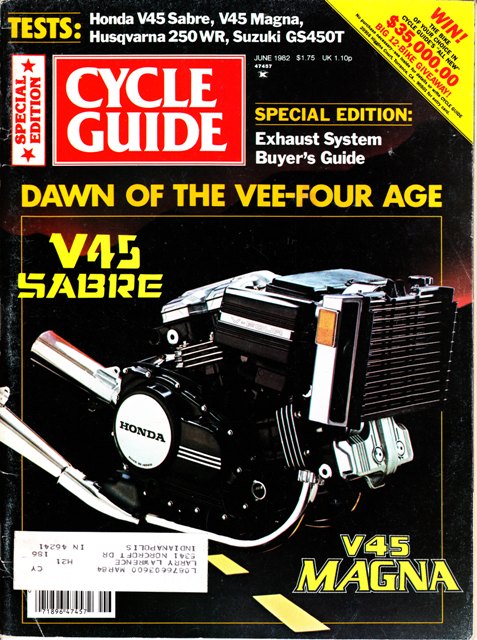
When Honda came out with its stunning line of V-4s in 1982, Cycle Guide called it the dawn of a new age.
Cycle Guide Magazine was one of the countless special interest magazines that popped up in the 1960s and ‘70s. The magazine was launched in 1967 by Kable News Company, one of the nation’s leading magazine distribution companies. Originally Cycle Guide was intended for the do-it-yourself motorcycle rider and tinkerer, with detailed articles on how to work on your bike.
Cycle Guide grew rapidly to a circulation of around 90,000 by the early 1970s to become one of the larger motorcycle books. Still Cycle Guide was about half the circulation of the big three – Cycle, Cycle World and Motorcyclist. Through the ‘70s circulation actually began to drop. In 1978 Cycle Guide’s owner George Dougherty, brought in Car and Driver’s executive editor Steve Thompson to do a complete overhaul of the magazine. In November of ’78 the new look Cycle Guide was introduced. Thompson said he felt that the magazine was very close to being killed and his hiring was a last-ditch effort by Dougherty to save the magazine.
It worked. Under Thompson’s guidance, and with the addition of some new editors, Cycle Guide took off and reached a circulation of 200,000 in February of 1981. In other words, the publication doubled its readership in just over two years, a remarkable accomplishment.
Cycle Guide did some unique things for motorcycle books of the time. It presented its articles in a block, in other words you didn’t have to go to the back of the magazine to finish an article. They used full-page photos of motorcycles at speed from unique angles for the background of their contents page. Also multiple editors gave their own mini-reviews of a motorcycle being tested and they could disagree with one another. That was different. Magazines before generally presented one voice when giving the opinion of a motorcycle. And lastly, Cycle Guide gained a reputation for naming definitive winners in head-to-head tests. All of this was done on a shoestring budget when compared to the other three major motorcycle books.
“We had to do it with less than our competition a Cycle, Cycle World and Motorcyclist,” Thompson said. “George (Dougherty) was extremely stingy. For example when Paul Dean (former Cycle Guide editor) was hired at Cycle World, we, at the time I was writing for him, went to Laredo (Texas, at the Uniroyal 5-mile test track) with the then new GSXR750 and captured six or 12, I don’t remember, FIM world speed records. That cost a huge amount of money which CBS had. Cycle Guide had very few resources.”
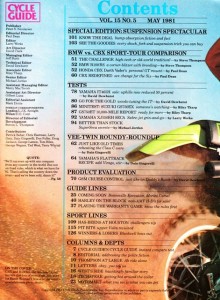
Photographers had to be creative to come up with a shot that would work on Cycle Guide’s contents page.
Thompson, Frank Conner, Sam Moses, Art Friedman, Jeff Karr, Paul Dean, Michael Jordan, Larry Works, Charles Everitt, Ron Lawson, Jerry Smith, Riley Tharp, Joe Kress and on and on. The roster of talented editors was deep for the number four motorcycle magazine. In addition they brought a slew of talented contributing writers such as famous Brit motoring journalist L.K.J. Setright, Ted West, George Larson and young up-and-coming photographers like Patrick Behar, David Dewhurst and Tom Riles.
But the real star to emerge from Cycle Guide was a young west coast road racing champion named Dain Gingerelli. “Daingerous Dain” became the face of Cycle Guide and interestingly enough Dain says that was by design.
“I think Steve (Thompson) realized it was important to have a “name” editor and they cultivated that with me,” Gingerelli said. “Part of it was I was the sport editor and I got to ride all the cool race bikes. I rode with Kenny Roberts around Willow, tested Eddie Lawson’s world championship-winning Yamaha and things like that. That gave me a lot of exposure to the readers.”
Gingerelli said it was that re-tooled Cycle Guide that came out in November of 1978 that really got him keyed up about the magazine.
“I read that issue and got so excited that I went to their office and told them if there were ever any openings to give me a call. Sure enough when Jeff Karr left Paul Dean got in touch with me.
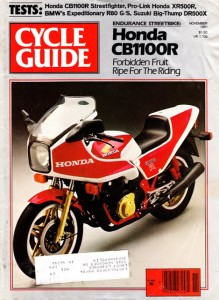
Cycle Guide tested Honda’s gorgeous CB1100R in the Nov. 1981 issue. It was as close as you could get to a four-stroke Formula One bike at the time. Unfortunately this dream bike wasn’t available in America.
“I remember the first test I did for the magazine was a Kawasaki KZ650. Paul Dean was showing me how they conducted tests and when it came to the 60-0 mph stopping test I was really at the peak of my racing and I guess I turned in a really impressive stopping distance. Now Paul wondered if I could do even better. I tried again and did better. He kept wanting to see if I could shorten the distance even more and final I just nailed the brakes with all I had and bam! It spit me down. I totaled the bike and dislocated my shoulder. This was my first test and I thought I was done. At the hospital Paul was with me and he said, ‘I hope this doesn’t change you mind about coming to work for the magazine.’”
Cycle Guide published until 1987. “One day Peter Nicolaysen (publisher) came in and said, ‘Well guys, this is the last issue,’ and that was it,” Gingerelli said. “I think the owner thought bicycle magazines were the future and they had just started one and I think he was just stretched too thin. The hand writing was on the wall though. We’d gone from monthly to nine issues a year in the last year or two.”
And with that the 20-year history of Cycle Guide came to an end.
Unlike reunions held by staffers of Cycle Magazine, there was just one attempt to do the same for former Cycle Guide alumni, but for some reason according to Thompson know one seemed particularly interested. “I think it was a bad ending for a lot of the people and that’s what they remembered.”
In the end Thompson said he is proud of what Cycle Guide was able to accomplish, especially given its financial constraints. “Some really talented people were in those pages,” Thompson said. “And I could be just succumbing to self-induced delusion, but at its peak in the early 1980s I think Cycle Guide built an esprit de corps with the readers and helped reshape what was expected from a motorcycle magazine.”
 Rider Files
Great pass down Memory Lane as always LL!
Jerry and Dain hooked up and started a ‘new’ Cycle Guide site on Blogspot last year, but haven’t heard much out of them since before the holidays:
http://cycleguidemagazine.blogspot.com/
Thanks for the memories!
Stu
LikeLike
Stu
Dain’s told me he’s busy working at Motorcycle Bagger magazine right now so hasn’t done anything with the blog of late.
Thanks for the comments Stu. We’ve got to get together for lunch at the rib place here in town soon.
LikeLike
Since I started reading Cycle Guide in the mid-80’s the thing I remember most was chroming their pick for bike of the year.
LikeLike
When I was in high school in the late seventies I was a subscriber to Cycle Guide. At some point there was an article written by one of the editors about his experiences in College. I read it without paying much attention to the details. In the story he told of “racing” his bike (Triumph?) up the street in front of the frat houses and making the 90 degree turn in front of the dorms. One day there was a particular girl standing around so he needed to make a particular impression, which he did by crashing right in front of her. I guess it all worked out in the end, but I forgot about it. Several years later, having chosen to go to Beloit College, I was walking down the road in front of the frat houses looking at the 90 degree turn in front of the dorms and I had a sort of deja vu. The following summer when I went home i rummaged through the old mags for hours but I finally found the issue. It was a fabulous coinsidence. I hope I have the right magazine, I subscribed to quite a few then. Does any one know if any of the editors of Cycle Guide went to Beliot? And of course I eventually learned to race at Blackhawk Raceway 15 minutes away.
LikeLike
I’d forgotten about the chromed Motorcycles of the Year. That was cool.
Oh and Ed, you’re talking about Art Friedman. I remember that article. Art was at Cycle Guide in the mid-’70s before moving to Motorcyclist.
LikeLike
I see no mention of Bob Braverman and Walt Fulton, Jr. who were the workhorse team at Cycle Guide back in the early 70’s. I enjoyed the tests and how-to projects. A high level of knowledge and enthusiasm came from these guys. I looked forward to each issue.
LikeLike
Those are the guys I remember too.
LikeLike
I was the last editor at Cycle Guide, and still remember when George Dougherty came in and announced he was closing the magazine. He’d decided that bicycling was the up and coming market, and put all his eggs in that basket. Bicyclist lasted about another year, and a bunch of talented writers were left by the wayside.
LikeLiked by 1 person
My mistake: “Cyclist” was Dougherty’s brainchild
LikeLiked by 1 person
Last week I was perusing southern Texas on a map, saw Big Bend National Park and recalled a touring article in Cycle Guide, in 1973, I think, “Riding the Big Bend Country.” So I got curious about what happened to the author, Frank Connor. Found his obituary:
https://www.mckoon.com/obituaries/Frank-Conner/#!/Obituary
LikeLiked by 1 person
I was really upset when I heard they were closing ! I had just won a motorcycle thru them! An 1987 Kawasaki EN 450! I put on 36000 plus miles on that bike. Put it up for the winter in 2000 and that spring one of my girls cam down with leukemia! Then 3 months later , the wife left ! With no time to ride, (working and taking care of her) it sat for 3 years. When we were forced to move, I gave it to a friend of hers who helped us move! He got it running, then moved himself to college town! Was a great bike! Hauled my wife and I along with saddle bags and large pack to Laconia bike week without a whimper!!
LikeLiked by 1 person
i am looking of cycle guide feb 1970 with a decent cover. thanks.
LikeLiked by 1 person