Indy Supercross: A Year-by-Year History
By Larry Lawrence
1992: The Inaugural Race
The Hoosier Dome was built in 1983 but had to wait almost a decade before it hosted its first-ever AMA Supercross on March 21, 1992, before a crowd of 50,415. Honda’s Jeff Stanton rode persuasively to victory, beating teammate and defending champion Jean-Michel Bayle by about one second. It was Stanton’s 15th career supercross win. The race proved pivotal in the championship chase when points leader Damon Bradshaw crashed on lap 12, finishing last and losing the lead he’d held since the second race of the season. In the 125cc Eastern Regional main, DGY Racing’s Jimmy Button won for the second consecutive week, beating series points leader Brian Swink.
1993: McGrath’s Dominance Begins
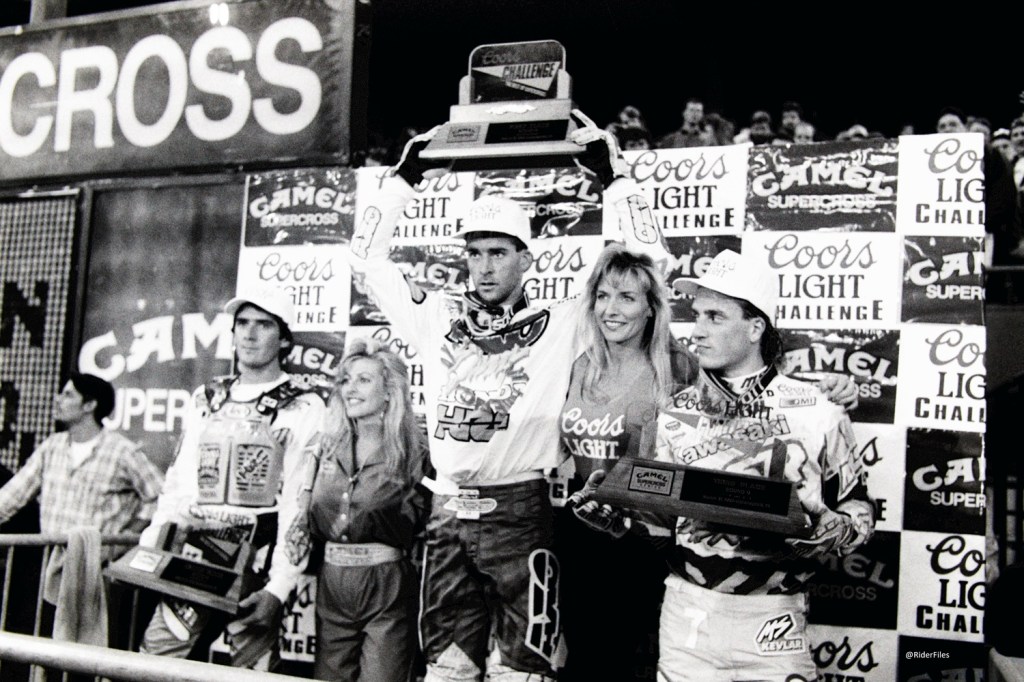
Jeremy McGrath claimed his eighth win of the season on April 24, dominating in front of 46,346 spectators at the Hoosier Dome. The 21-year-old Honda rookie took command early and pulled away, moving within one win of tying Damon Bradshaw’s single-season record of nine victories. McGrath’s teammate Steve Lamson finished second for his best career result. Local hero Mike LaRocco returned from a broken wrist to compete in front of his hometown crowd, finishing ninth. The event also marked the final round of the Eastern Regional 125cc series, won by Doug Henry, who had already clinched the title.
1994: McGrath Makes It Two Straight
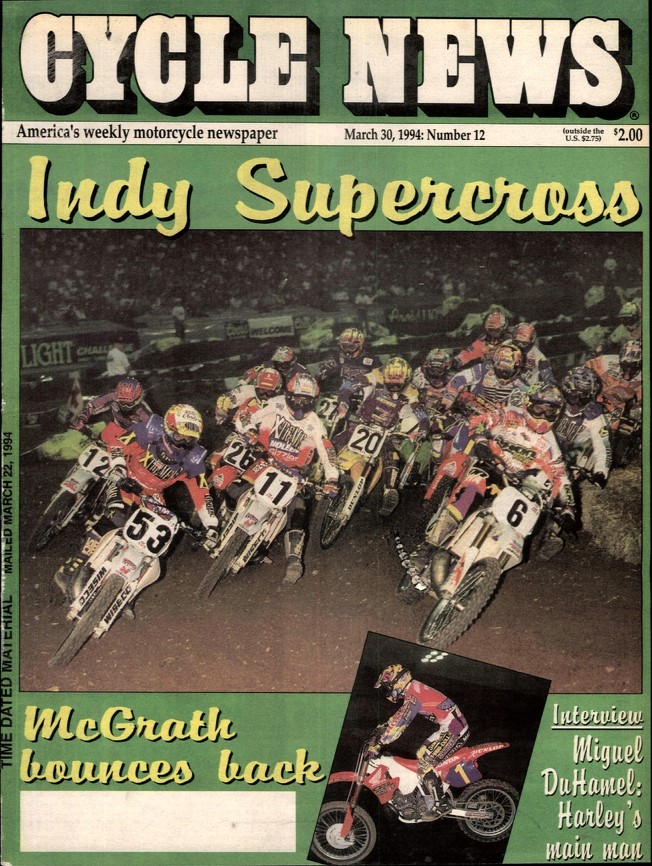
Defending champion Jeremy McGrath collected his sixth victory of the season on March 19, extending his points lead on a challenging, rutted track. Despite twisting his ankle in his heat race, McGrath took the lead at halfway and never looked back, beating Jeff Emig by approximately three seconds. Mike LaRocco thrilled his home-state crowd with a third-place finish after working up from ninth on the first lap. In 125cc action, Ezra Lusk dominated both his heat and the main event, scoring his fifth win in six races.
1995: McGrath’s Revenge
After disappointing finishes in Atlanta (fourth) and Daytona (seventh), Jeremy McGrath arrived at the RCA Dome (formerly Hoosier Dome) on March 18 with doubts creeping into his confidence. He called it “revenge week” and delivered his sixth win of the season—his third straight at the facility—in front of 42,244 fans. Ryan Hughes thrilled with a runner-up finish, while hometown favorite Mike LaRocco struggled to third after crashing in his heat race. In 125cc action, Mickael Pichon came from seventh to score his second win of the season.
1996: McGrath’s “Nine Lives”
March 30 delivered one of McGrath’s hardest-earned victories. After an uncharacteristically bad start left him seventh on the first lap, the three-time champ systematically picked off riders on the technical Indy track. He climbed to second by lap eight, then inherited the lead when Jeff Emig crashed while holding a five-second advantage. McGrath’s 10th consecutive win had 45,217 fans on their feet. Ezra Lusk earned his first podium with third, while Mickael Pichon cruised to victory in the 125cc main.
1997: Emig’s Statement Win
Jeff Emig delivered perhaps his strongest supercross performance on February 15, leading wire-to-wire in front of 50,815 fans—the first time he’d led start to finish without being passed. Despite plastic banners tangling in his rear wheel on lap two, nearly costing him his brakes, Emig held off Larry Ward, points leader Doug Henry, and defending champ Jeremy McGrath. An inspired Mike LaRocco clawed from seventh to take second before his hometown crowd. The race also opened the 125cc East Coast series, with John Dowd methodically working to victory.
1998: McGrath Makes History
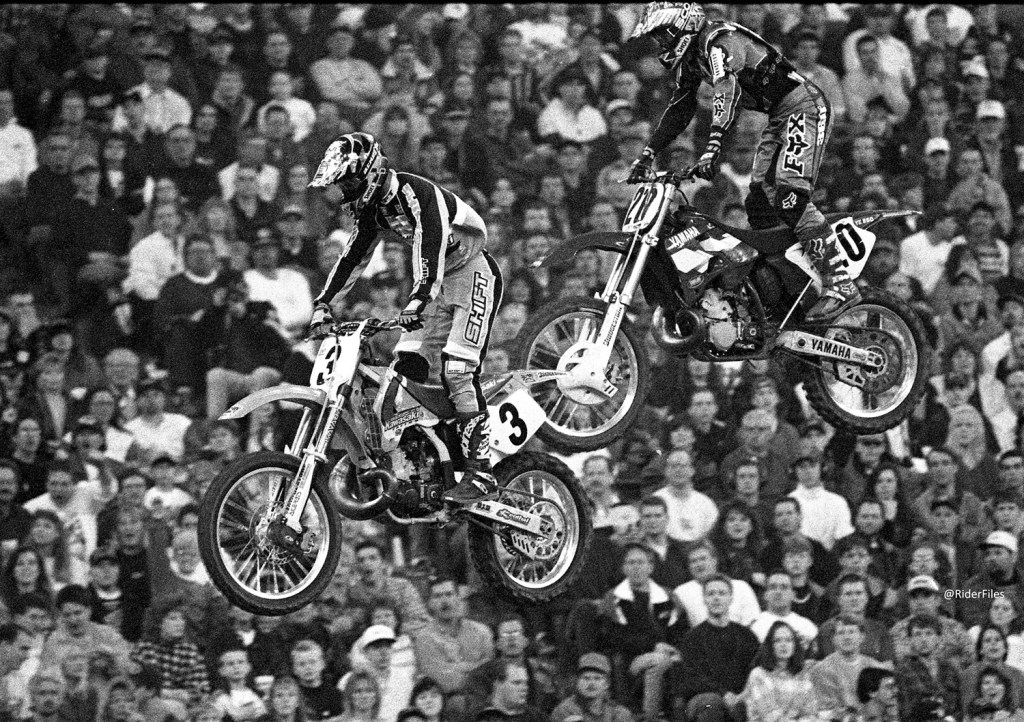
February 14 saw Jeremy McGrath post his third straight main event victory before 52,784 spectators, stretching his series lead to a commanding 45 points. More significantly, the win was his 48th supercross success and 64th AMA Pro career win (including outdoors), putting him atop the all-time SX/MX win list. Larry Ward gave Suzuki its first podium of the year with a strong second, while Jimmy Button grabbed his second consecutive podium with third. Ezra Lusk’s title hopes took a devastating hit when he crashed on the first lap, possibly breaking his hand.
1999: Lusk Claims Triple Crown
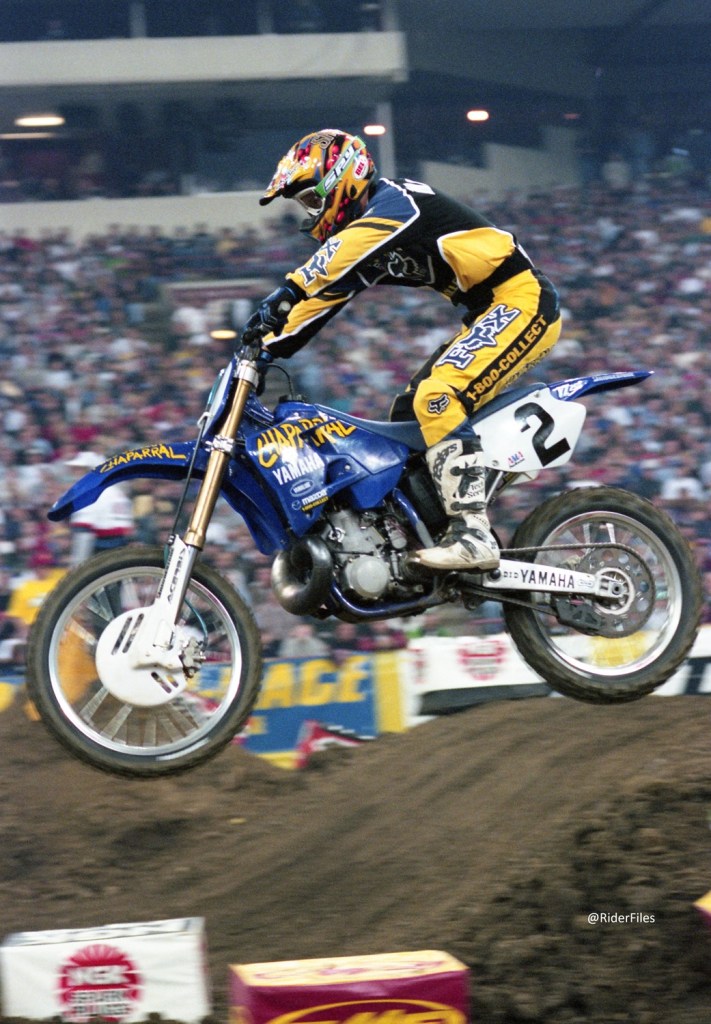
With Jeremy McGrath having already clinched the championship, attention turned to the Vans Triple Crown series-within-a-series on April 24. Ezra Lusk rode to victory in front of 46,831 fans, claiming the $25,000 bonus after McGrath was collected in a first-turn pileup. Mickael Pichon finished second despite a sore shoulder and ankle, while Tim Ferry earned his best-ever 250cc finish with third—the first privateer podium of the year. McGrath’s spectacular ride from 17th to fourth after two crashes earned him post-race praise.
2000: McGrath’s Flu Game
Jeremy McGrath wasn’t supposed to win this one. Laid flat with the flu for three days before the race, he hadn’t ridden or trained. Many wrote him off—especially after he crashed in his heat race. But en route to second in that heat, McGrath turned the fastest lap of the night. In the main, he grabbed the holeshot and simply disappeared, winning by over 10 seconds. “I guess one week doesn’t do too much damage as long as you take care of yourself,” the sniffling champion said from the podium.
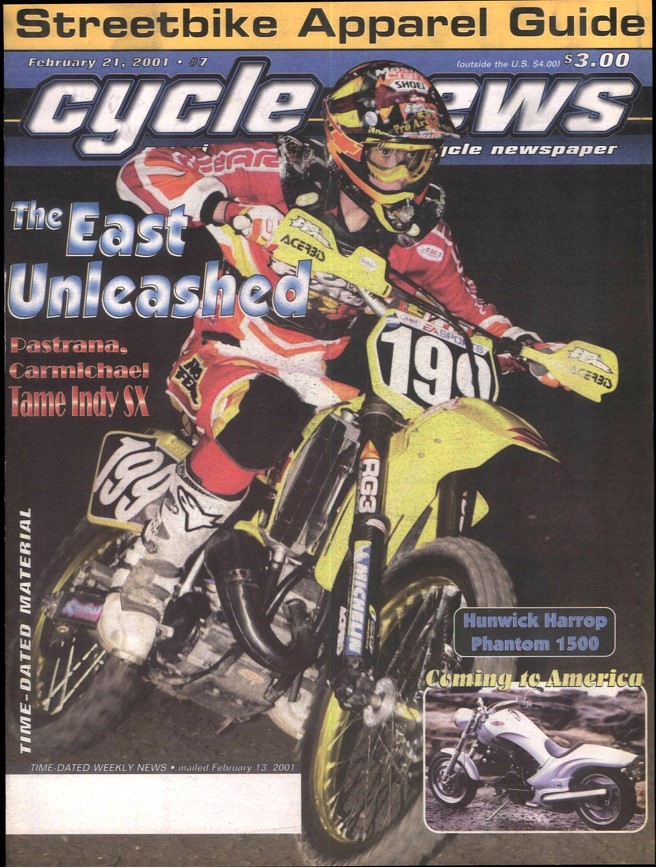
2001: Carmichael Cruises
February 10 marked Ricky Carmichael’s most convincing victory of the season. From the moment he shot out of the gate like a “bee-stung kangaroo,” the Kawasaki rider owned the one-lined, rutted track, building a 12.2-second margin of victory before 55,912 fans. He was the only rider consistently clearing a triple-triple-triple section, gaining time each lap. Jeremy McGrath worked hard to pass Tim Ferry for second, but by then Carmichael had vanished. Local hero Mike LaRocco rode from 12th to sixth after another wretched start.
2002: Vuillemin’s Last-Lap Magic
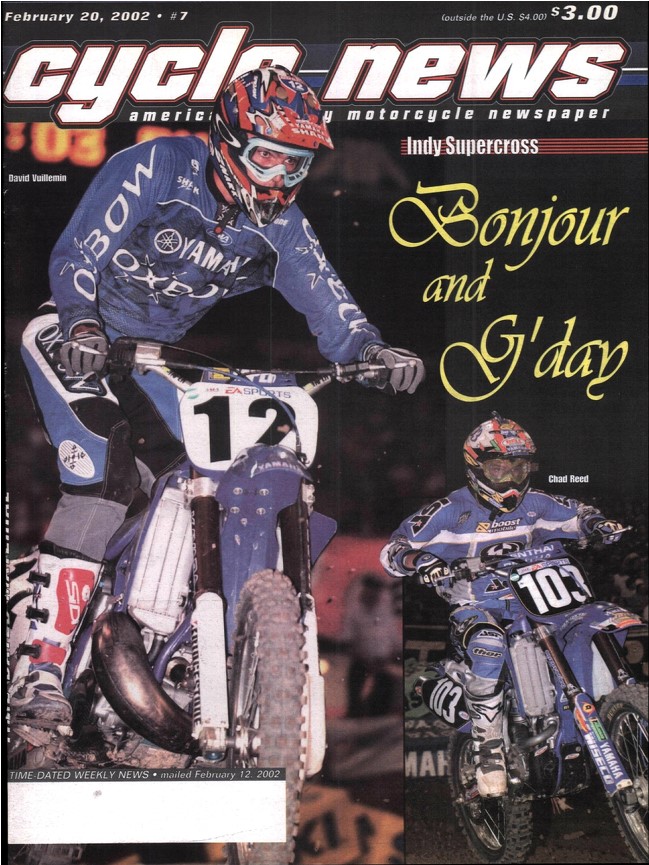
David Vuillemin went from villain to hero in a matter of hours on February 9. Booed mercilessly during rider introductions, the Frenchman silenced 57,883 fans with a daring last-lap pass on defending champion Ricky Carmichael for the win. The pass capped an intense battle that saw Travis Pastrana crash after contact with Carmichael earlier in the race. Vuillemin stretched his points lead to 28 over Carmichael. Stephane Roncada claimed his second consecutive podium with third, while Nate Ramsey finished fourth on Honda’s new CRF450R four-stroke.
2003: Carmichael Chases History
Ricky Carmichael claimed his sixth win of the season on March 1, moving within three of Jeremy McGrath’s all-time AMA National win record of 89. At just 23, Carmichael now had 86 career wins. Though not particularly popular in Indiana (lingering bad feelings from his 2002 contact with Travis Pastrana), Carmichael got out front early and held off David Vuillemin, who provided most of the racing action by charging from sixth to second. Chad Reed rounded out the podium after a long night that saw him struggle with comfort and confidence.
2004: LaRocco’s Homecoming Miracle
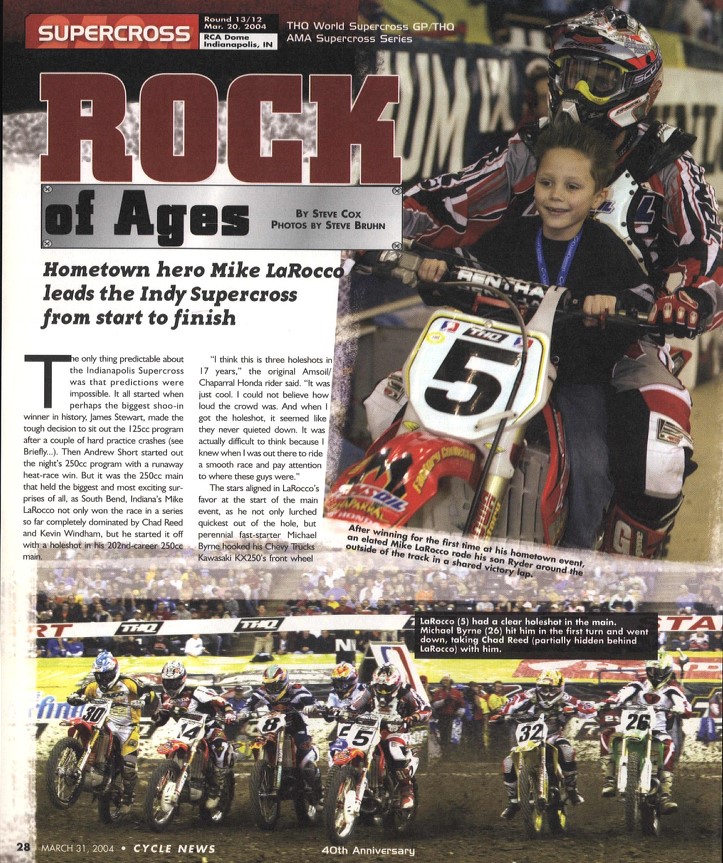
The only predictable thing about the 2004 Indy Supercross was that predictions were impossible. South Bend’s Mike LaRocco not only won the race in a series dominated by Chad Reed and Kevin Windham, but he started it off with a rare holeshot—only his third in 202 career 250cc mains. “I could not believe how loud the crowd was,” LaRocco said. “It was actually difficult to think.” Reed crashed in the first corner and charged from last to third, maintaining his sizeable points lead. In 125cc news, James Stewart sat out after practice crashes, with Joshua Hansen taking the win.
2005: Carmichael in the Zone
Ricky Carmichael recorded his fifth straight victory on his way to what would become a remarkable streak. In front of 52,838 fans, the seemingly unstoppable Suzuki rider took the checkered flag 5.8 seconds ahead of Chad Reed and 25.4 seconds ahead of Kevin Windham. Though he didn’t grab the holeshot, RC moved into the lead shortly after the second turn. Reed admitted, “His turns—he’s really got turns down, and I just feel like he is eating me up there.” The win gave Carmichael a comfortable 32-point gap over the defending champ.
2006: Carmichael’s Comeback and LaRocco’s Farewell
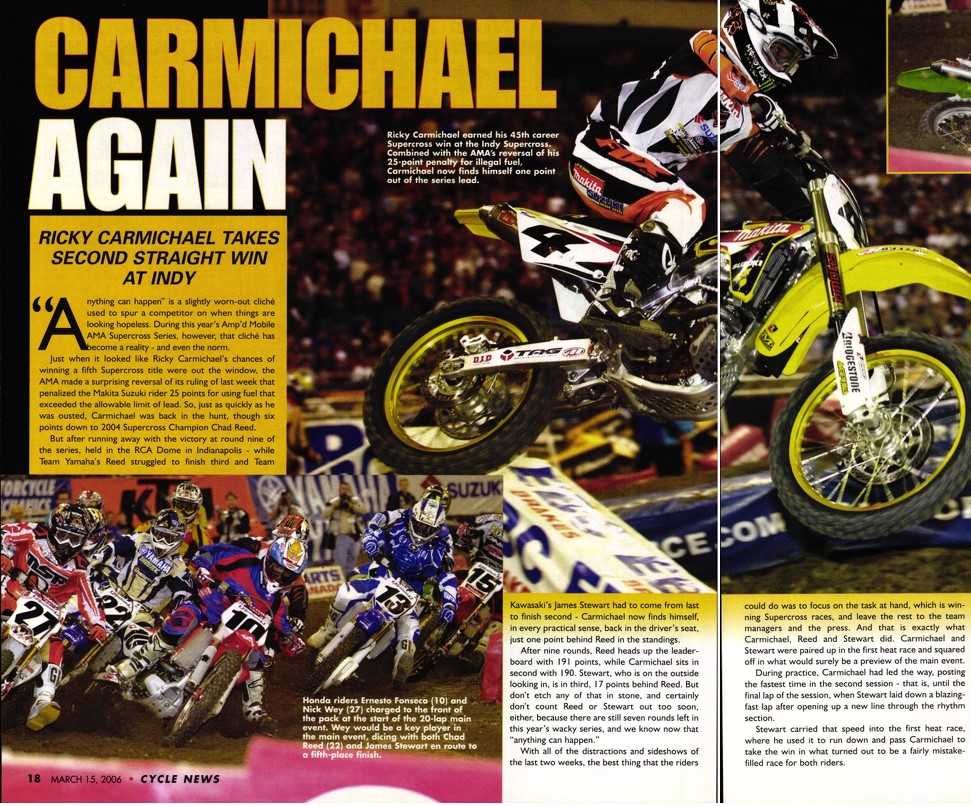
“Anything can happen” became reality in 2006. Just when Ricky Carmichael’s title chances seemed doomed by a 25-point penalty for illegal fuel, the AMA reversed its ruling. Carmichael then ran away with the victory at round nine, while Chad Reed struggled to third and James Stewart charged from last to second. Carmichael now sat just one point behind Reed in the standings.
The night belonged also to Mike LaRocco, who announced his retirement before his hometown crowd, effective season’s end. After 20 years, 229 supercross starts (more than any other rider), and 81 podiums, the 35-year-old Indiana native went out for practice and injured his wrist, unable to compete. His son Ryder participated in the KTM Jr. Supercross Challenge, finishing seventh.
2007: Stewart’s Thrilling Charge
March 24 delivered one of Indy’s most memorable races. Chad Reed grabbed the holeshot while James Stewart was squeezed out in the first turn, dead last. Unimpeded by traffic, Reed gapped the field, but Stewart was turning laps 0.7 seconds faster. On lap 14, Stewart pulled even and made a clean pass for the lead, pulling away to an easy win before 54,626 fans. In the Lites class, Ryan Dungey grabbed the holeshot and rode a steady, uneventful race to his second win of the series.
2008: Reed’s RCA Dome Farewell
Chad Reed got back on the winning track at the final supercross ever held at the RCA Dome. He grabbed the holeshot and pulled away to an easy win before the venue gave way to Lucas Oil Stadium. Josh Hill battled for the runner-up position before inheriting second when Davi Millsaps crashed on lap 17. In a wild Lites division, Trey Canard won after Ryan Villopoto crashed while attempting a pass, putting both on the ground. Canard retook the lead when Branden Jesseman stalled, then pulled away for the win.
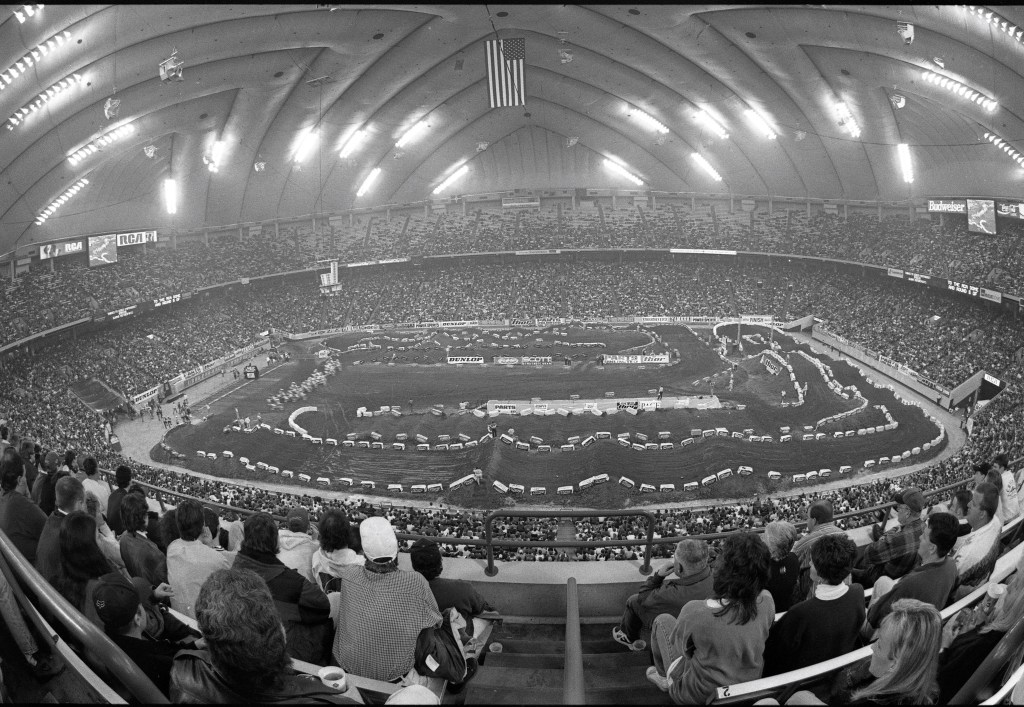
2009: First Race at Lucas Oil Stadium
Over 61,000 fans witnessed the first supercross at the new Lucas Oil Stadium. Chad Reed finally got the start he’d been seeking and made it pay off, going head-to-head with James Stewart on one of the toughest tracks of the year. Stewart turned the fastest lap and passed Reed on lap 13, but Reed kept the pressure on and Stewart went down. Reed took the victory by just over two seconds, moving into a tie with Stewart for the series lead. Mike Alessi earned his first-ever 450-class podium with third.
2010: Villopoto’s Improbable Win
Ryan Villopoto did everything he could to make things difficult on February 20. He crashed in his heat race, had to qualify through the LCQ, and earned one of the worst gate picks possible. Despite all obstacles, the Kawasaki rider stayed calm, methodically picked his way through the field, and pulled away to a 3.6-second victory over Ryan Dungey before 60,019 fans. The win drew Villopoto even with Dungey in the series standings. Kevin Windham, who led early, admitted, “Being fast all night kind of got to me.”
2011: Villopoto’s Masterpiece
Ryan Villopoto delivered a nearly flawless performance on March 12, leading all 20 laps in front of 60,789 fans and pulling out a 6.3-second victory over James Stewart. Chad Reed rode bravely to third despite a stomach ailment. The win pushed Villopoto’s points lead over Stewart to 26—a milestone since a race win is worth 25 points. In Lites action, Ryan Sipes captured his first career victory after leader Blake Baggett crashed hard coming off the finish line jump.
2012: Villopoto’s Sixth Victory
For the sixth time in the 2012 season, reigning champion Ryan Villopoto stood atop the podium at Lucas Oil Stadium. After starting mid-pack, he worked his way forward, passing Brett Metcalfe for second on lap 10 and Justin Brayton for the lead five laps later. “This was by far the hardest track of the season,” Villopoto said. James Stewart was sidelined after being struck by Kevin Windham during his heat race. In Lites action, Blake Wharton took his first win of the season after leader Ken Roczen crashed and suffered a mechanical problem.
2013: Villopoto’s 30th Career Win
Ryan Villopoto held off a late charge by Ryan Dungey to claim his second-straight Indy win and sixth victory of the season on March 16. The win marked his 30th career supercross victory and extended his points lead to nine. James Stewart stalled on lap six while leading, handing the top spot to Villopoto. In 250 East action, Marvin Musquin delivered a stunning comeback from 16th on the opening lap to win after leader Blake Wharton crashed on the final lap.
2014: Dungey Masters the Mess
The 2014 Indy Supercross was brutal—so technical it was hard to keep up with all the crashing. Ryan Dungey emerged master of the rutted, gnarly mess to score his first victory of the season in front of 59,919 fans. The win triggered a major championship shakeup when points leader Ryan Villopoto and second-place Ken Roczen both crashed on the start straight, with third-place James Stewart also going down in the first turn. Eli Tomac and Cole Seely posted career-best finishes with second and third.
2015: Dungey’s Perfection
Ryan Dungey was flawless on a highly technical track before a massive crowd of 60,491 fans. He took the lead on the first lap and pulled away to a comfortable 3.9-second victory over Cole Seely and Trey Canard. The win marked Dungey’s fifth of the season and made him the fifth rider in history to win back-to-back races in Indianapolis. Notably, the winner of the Indy race has gone on to win the 450SX championship 17 out of 23 times.
2016: The Battle for the Ages
April 9 delivered arguably the most exciting battle for victory of the 2016 season. Ryan Dungey and Ken Roczen went toe-to-toe for 20 laps, trading the lead multiple times in front of 60,085 fans. Roczen finally made a pass stick on lap 16, bringing the crowd to its feet, but immediately made a mistake rolling the finish line jump, allowing Dungey to jump back out front. Dungey won by 1.7 seconds, earning his 29th career victory and 29th consecutive podium—extending his record streak.
2017: Tomac’s Three-Peat
Eli Tomac made it three wins in a row on national television, taking the lead on lap three and riding away to a 5.85-second margin of victory. The win marked the first time in his career he’d won three consecutive supercross races and narrowed the gap to series leader Ryan Dungey to just 12 points. Ironically, Dungey’s teammate Marvin Musquin helped Tomac by passing Dungey late in the race, relegating the points leader to third. Blake Baggett scored his second holeshot of the season and led early.
2018: Musquin’s Moment
Fans finally got the showdown they’d been waiting for: Marvin Musquin out front with Eli Tomac giving chase. But it didn’t last. After matching each other’s pace, Tomac went down hard, down for nearly 75 seconds. Musquin cruised home to win by 29.4 seconds. Points leader Jason Anderson crashed in turn one but recovered remarkably for fourth. The win narrowed Anderson’s points lead to 35 with five rounds remaining.
2019: KTM Sweeps
Marvin Musquin finally got it done at Indy, nailing the holeshot and leading the entire way despite pressure from behind. Blake Baggett finished second, with series leader Cooper Webb third—giving KTM a podium sweep. The victory narrowed Webb’s points lead over Musquin to just 14 with six rounds remaining. Webb nearly crashed while passing for position, running over a Tuff Block but recovering for the podium spot.
2020: No Race
The Indy Supercross was canceled due to the COVID-19 pandemic.
2021: Roczen’s Indianapolis Residency
With a modified schedule due to COVID, Indianapolis hosted three races in one week.
Indy 1: Ken Roczen held off defending champion Eli Tomac, winning by 1.6 seconds to become the fourth different winner in four races. Tomac grabbed a rare holeshot but washed out on lap three, handing the lead away. Zach Osborne delivered the ride of the night, coming from dead last (stuck in the gate) to finish fifth.
Indy 2: Roczen became the first repeat winner of 2021, claiming back-to-back victories for the first time since 2017. Justin Barcia grabbed the holeshot but Roczen charged past within the first few corners. A battered Zach Osborne (four fresh stitches from a practice crash) was the lone Husqvarna rider after Jason Anderson dislocated his finger.
Indy 3: Roczen made it three in a row in seven days, sweeping Indy’s residency and stretching his points lead to 16 over Cooper Webb. The win didn’t come easy—he nearly got T-boned by Barcia, and late drama saw Barcia collected by a lapped rider, taking out an oncoming Tomac in the process.
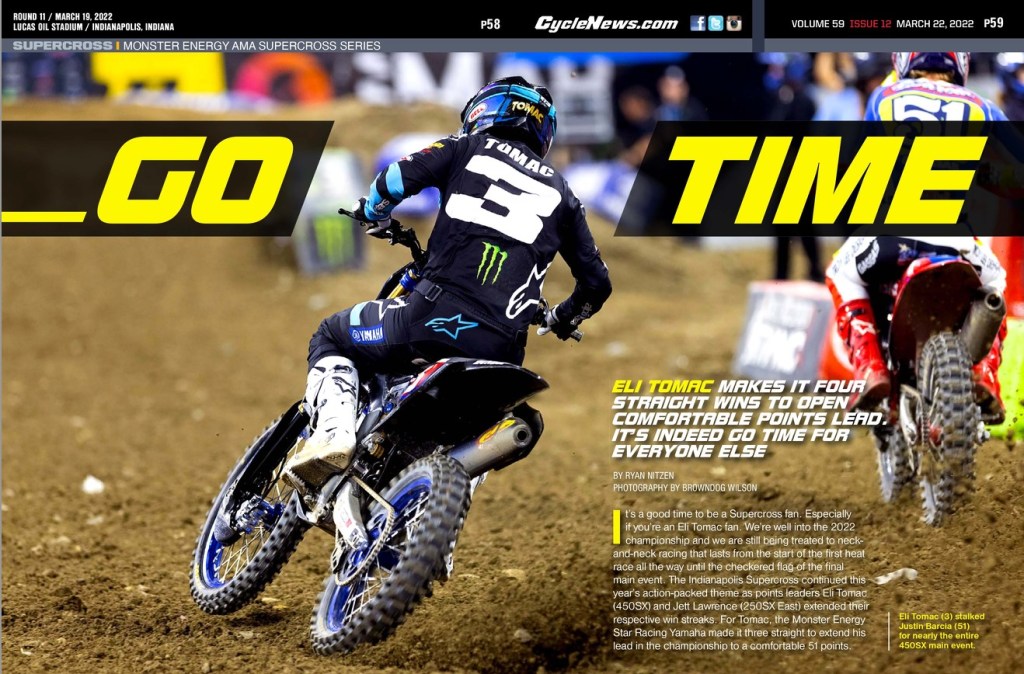
2022: Tomac’s Fourth Straight
Eli Tomac claimed his fourth consecutive win and sixth of the year in a 27-lap main event. Starting fourth, he passed Malcolm Stewart, then stalked Justin Barcia for nine laps before making a clean move for the lead. Drama unfolded when Jason Anderson and Barcia tangled, leaving Anderson on the ground. Marvin Musquin caught Tomac late but couldn’t hang on, settling for third. Tomac stretched his points lead to 42 over both Anderson and Malcolm Stewart.
2023: Roczen’s Suzuki Triumph
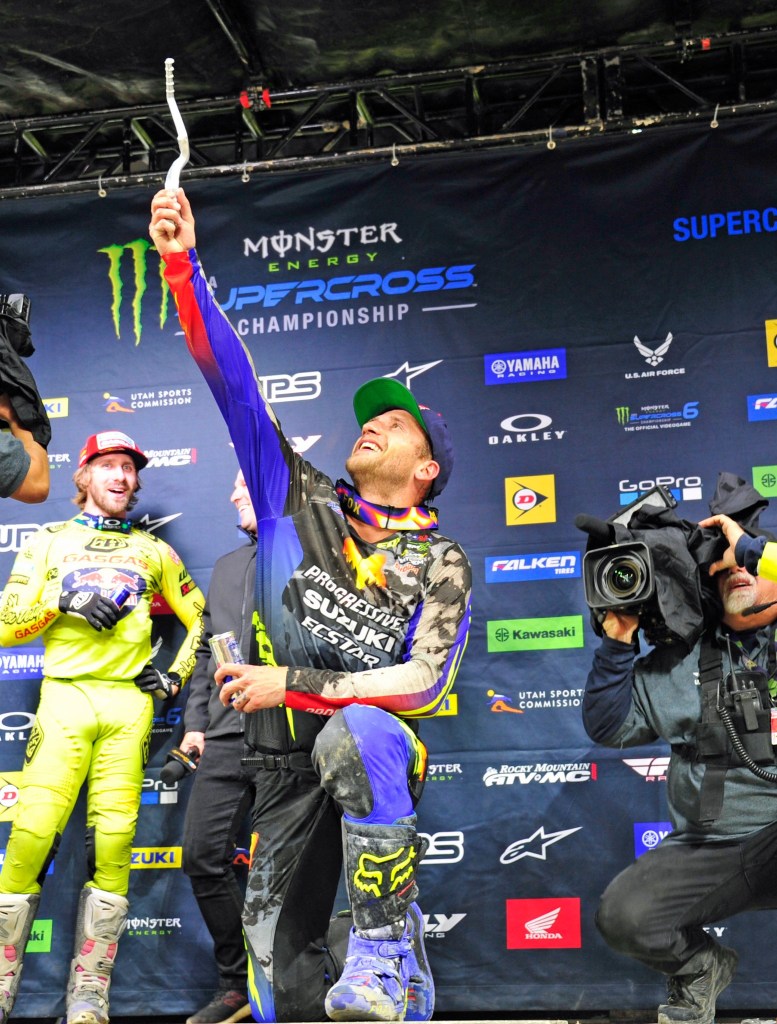
Round nine delivered another insane night of racing. Ken Roczen grabbed the early lead and held on through intense pressure from Justin Barcia, who closed in during the final laps. Both riders made big mistakes, but Roczen held on by just 0.7 seconds—his first win with the HEP Suzuki Team. Cooper Webb ran second for most of the race before giving way to Barcia, then cruised to third, taking control of the points lead by one over Eli Tomac (eighth).
2024: Lawrence Sweeps Triple Crown
The Triple Crown format delivered three exciting mains. Jett Lawrence swept all three 450 races for his third straight win, growing his championship points lead. Ken Roczen battled Lawrence in every race, going 2-2-3 for second overall. Chase Sexton improved with each race (3-3-2) for third. In the 250 class, Cameron Mcadoo won the overall.
2025: Webb’s Dominant Statement
Cooper Webb dominated from start to finish, grabbing the holeshot and leading every lap of the main event. At one point he held an 11-second lead over second place before cruising to victory, extending his points lead to 15 over Chase Sexton. “I was pissed off” after mistakes in practice, Webb admitted. “I wanted to go out in the main event and get back on point.” Justin Cooper earned a career-best second place after Chase Sexton crashed in the sand late in the race. Justin Barcia grabbed the holeshot and finished fourth for his best result of the year.
 Rider Files