I was going through some of my collection of old motorcycle magazines and came across a very interesting article in the January 1987 issue Motorcyclist. The staff and outside contributors did a comprehensive 16-page article on the future of motorcycling. It delved into the technology and direction of the pastime in general. It’s a fantastic read and I thought I would look at how accurate the journalists of Motorcyclist were on their predictions of motorcycling’s future from 38 years ago. You may be surprised.
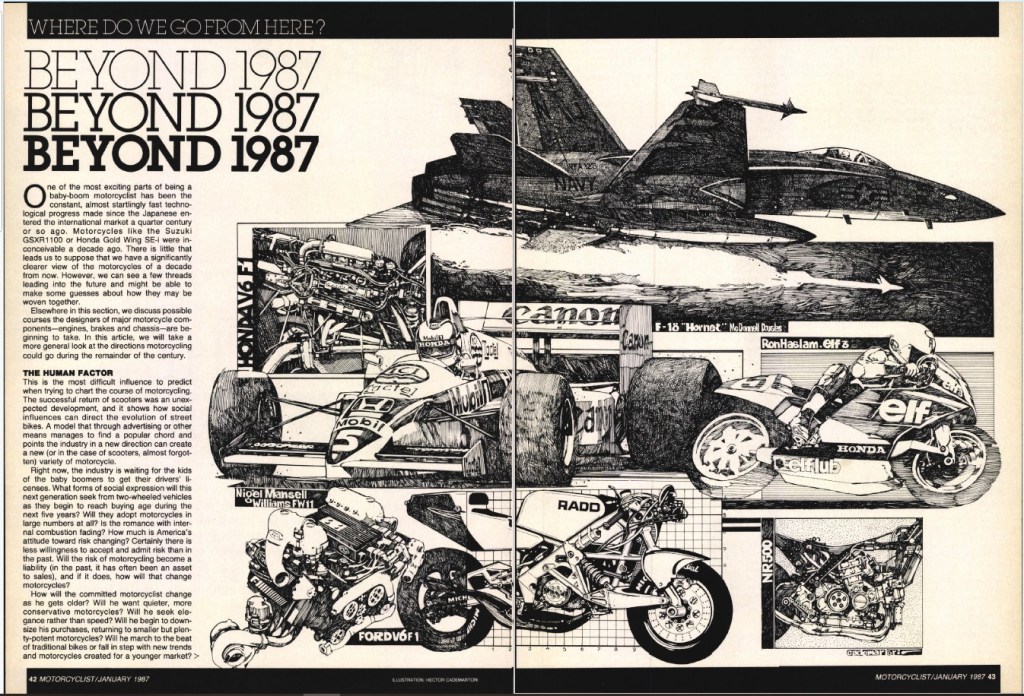
This 1987 Motorcyclist magazine feature, titled “Beyond 1987,” delved into the anticipated future of motorcycles, exploring technological advancements, market trends, and rider demographics. The core premise was to predict how motorcycles would evolve beyond the late 1980s, driven by factors like Japanese innovation, rider aging, and political influences.
Predictions that Came Closest to Being Correct:
- Rise of Sport-Tourers: The article correctly identified the growing importance of bikes that blend sport and touring capabilities. While the term “sport-tourer” has evolved, the market for comfortable, capable motorcycles that can cover long distances quickly and comfortably is certainly a significant segment today (e.g., modern adventure touring bikes, certain sport-touring models).
- Advanced Electronics and Rider Aids: The prediction of “smart” systems like anti-lock brakes (ABS) and traction control (TC) was remarkably accurate. These technologies are now standard on many modern motorcycles, significantly enhancing safety and performance. While the article didn’t explicitly name them, the general concept of computer-controlled assistance for braking, acceleration, and handling is spot on.
- Sophisticated Suspension Systems: The feature’s emphasis on advanced suspension, moving beyond basic telescopic forks, also proved largely correct. While radical alternative front ends like hub-center steering haven’t become mainstream, modern motorcycles widely incorporate highly sophisticated suspension systems with advanced damping, adjustability, and often electronic control (e.g., semi-active suspension). Anti-dive systems, in various forms, have also been integrated into many designs.
- Increased Use of Plastics and Composites: The article predicted a greater reliance on plastics and composite materials for bodywork and even structural components. This has indeed materialized, with modern motorcycles making extensive use of lightweight and aerodynamic plastic fairings and increasingly incorporating carbon fiber and other composites in chassis and other parts to reduce weight and improve performance.
- Emphasis on Aerodynamics and Integrated Bodywork: The idea of “full-enclosed engines” and seamless, integrated bodywork for improved aerodynamics and aesthetics is a clear trend in modern sportbikes and even many touring motorcycles. Designs are increasingly streamlined, and mechanical components are often hidden for a cleaner look and better airflow.
- Computer-Aided Design and Manufacturing: The article’s mention of computers playing a crucial role in design and manufacturing processes was prescient. CAD/CAM systems are now fundamental to the motorcycle industry, enabling faster development, more precise engineering, and better integration of components.
While some predictions, like widespread “gearless drives” or mainstream “airbags” on motorcycles, haven’t fully materialized in the way envisioned, the core themes of increasing sophistication, electronic integration, and a focus on rider experience (through improved comfort, safety, and handling) were remarkably accurate.
 Rider Files