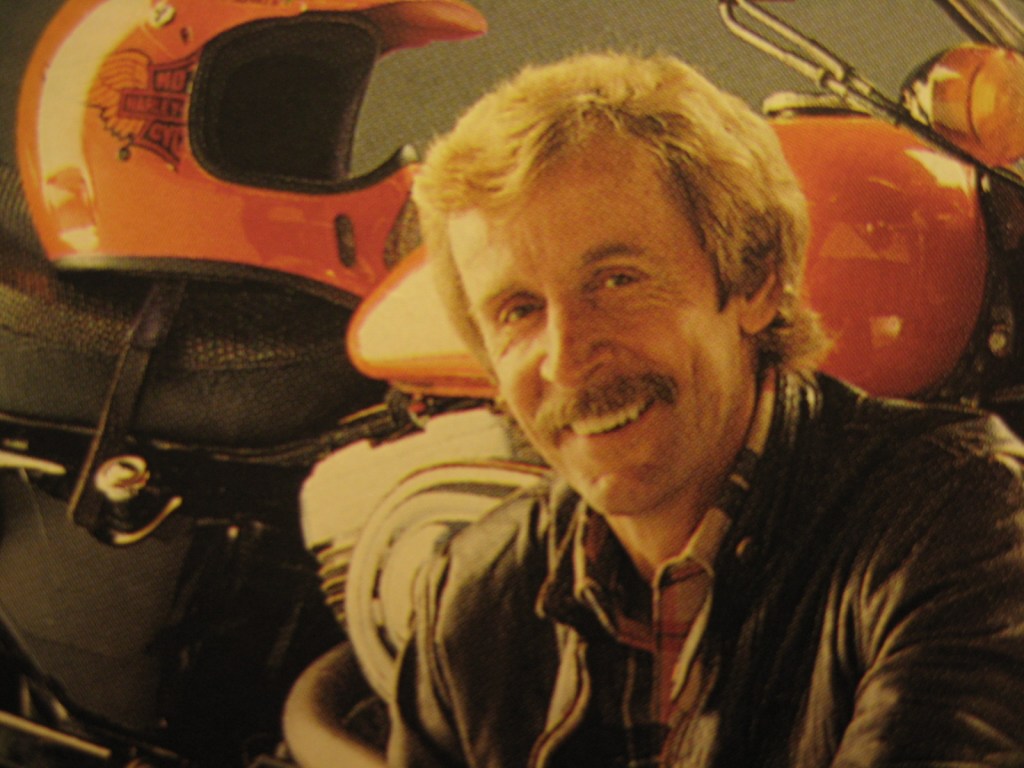
Sad to hear the news of the passing of Allan Girdler. To us motorcycle nuts he was best known as editor of Cycle World from 1976 to 1984. He did it all. Raced cars, bikes, wrote about both, was a newspaperman, farmer, author, raconteur and just all around good guy.
I’d randomly get calls from him from time to time to discuss topics such as, who was the greatest of all time, Ago, Roberts or Rossi.
I’d pick up the phone and his greeting was always the same – “Girdler here.”
He wrote a lot of books. I think I have all the motorcycle related ones, a lot on Harleys. He did well with those and some of them cost a pretty penny today.
One of the funniest things I remember him saying was commenting on how many he’d sold on one Harley book. It gave him the bright idea to write a history of NASCAR book. His reasoning went like this:
“If 50,000 people bought a Harley every year and we sold 10,000 Harley Buyer’s Guides,” he said. “and 50 million people watch NASCAR, that means 10 million of them are going to buy my book of NASCAR history. Right… It turns out you can enjoy NASCAR without knowing anything!”
I will miss those great phone calls with Allan.
Want to read some good stuff from Allan? Click here: https://www.cycleworld.com/authors/allan-girdler/
— Larry Lawrence
Here’s a story I wrote on Allan back in 2007.
—
The Extra Man
By Larry Lawrence
At dinners parties in the 1950s hosts would invite what was called an “extra man” so that the party wouldn’t end up being six married couples talking to each other.
Allan Girdler thinks of himself as the extra man at Cycle World. No longer a staffer, yet more integral to the magazine than a freelancer, he fills the gaps and produces the goods when called upon. When most of the CW gang was at the USGP at Laguna Seca for example, Girdler was off checking out the annual races at Pikes Peak.
It was once written that a person’s work ethic is shaped by their first real job. Girdler’s first real job was copy boy at a newspaper. He believes working at the paper gave him a solid foundation for the rest of his life.
“This was the most wonderful, ethical place you could imagine,” Girdler says. “These were hard-working, honest people. I realized I don’t have to be smart, I don’t have to be handsome, I don’t have to be charming, I don’t have to sell anything… all I have to do is tell the truth as god gives me to see the truth. I thought ‘This is it; this is what I want to do. I want to be a reporter.’”
Girdler eventually brought this journalistic ethic to motorcycling and his readers are the beneficiary.
Girdler is one of the respected motorcycle writers in the industry. In spite of being a best selling author and a wonderfully prolific writer, he sees his most important contribution to the industry as being the greatest talent scout in the history of journalism.
“When there were three major motorcycle magazines, the editors of two of them were my graduates,” Girdler says proudly. “There were three major car magazines and one of my guys was editing Road & Track and one of my guys was editing Motor Trend. These were all guys I hired.”
Girdler was born in New York City and raised in New England. He also had family and spent a lot of time in Florida where relatives were orange farmers. It’s come full circle for Girdler. Today he grows oranges, along with flowers, on his farm in Southern California. He went to college in Oklahoma, at that’s where he got the job as a newspaper reporter. Girdler moved to California in 1968 when he was hired by Car Life magazine. After CBS bought Car Life it moved Girdler to Road & Track. During this time Girdler also began his career as an author. His first book in 1973 was on van conversions, all the rage at that time. The book was in print for 25 years.
Dan Hunt brought Girdler to Cycle World in 1975. In short order Girdler was named editor, a position he held at that magazine from 1976 to 1984.
While at Cycle World he brought in talented writers such as Peter Egan.
“Egan retired the CBS writing prize,” Girdler says like a proud father. “CBS at the time had something like 28 publications and Egan won the prize every year so they just quit giving it. No one else could match him. Someone once read my stuff and gave me a chance, so I read all the contributions that came in. Peter submitted stories, but no one would read them because he was a Volkswagen mechanic in Wisconsin. No big-time editor would bother with someone like that. He sent us a piece and an associate editor came in and said you’d better look at this. I read it and I called him right up and told him ‘we were buying it and buying everything you write.’”
Girdler also caught John Ulrich on the rebound after he’d been fired by Cycle after a photo of the then yet to be introduced Honda CBX that ran in a Southern California newspaper was traced back to Ulrich.
“I hired John, one, because I knew he was a tremendous talent and two, he’d learned his lesson. Yes he can be prickly, but he’s ethical, honest and a hard-working sonofabitch.”
To this day Ulrich, who now owns and edits Roadracing World, is grateful for the faith Girdler had in him.
“I’ll say this, the guy gave me a job when nobody else would, because I had royally pissed off Honda,” Ulrich said. “After they objected to me getting a job, he had me test every Honda that came through the door for about a year. One time soon after I was hired they came down to the Cycle World offices to raise hell (circa 1978) and he tossed copies of the magazines containing my test reports, on the table and said, ‘Show me where these tests are unfair in any way.’ They couldn’t, the controversy went away.”
It wasn’t just Honda who found some displeasure in the reviews written by Cycle World during that era.
“During my tenure I was threatened by every one of the major advertisers,” Girdler says. “CBS backed me every time.
In return for their faith in Girdler, he returned it by providing readers with some of the most in depth reporting in motorcycling.
An example of this was a trip to Japan in the 1970s. Girdler, along with other journalists, was offered the opportunity to ride Honda’s revolutionary, but ill-fated, NR500 Grand Prix machine. Girdler fondly remembers hitting 150 mph on the NR. “To this day it’s the fastest I’ve ever gone on a motorcycle,” he says. After the test the journalist were offered the choice to go to race mini-bikes, or interview Shoichiro Irimajiri, designer of Honda’s early GP bikes.
“17 journos went to ride monkey bikes, me, Ulrich and one other person went and spent the entire afternoon with Irimajiri. I learned things that day that I still use.”
Current Cycle World Editor David Edwards got his shot at entering motorcycle journalism after Girdler first strongly recommending him to then editor Dale Brown at Cycle News in 1983.
“After 11 months of seasoning at CN, I got the call from Allan offering me the feature editor’s slot at Cycle World. Life was good!” Edwards said.
“He also did something for me several years earlier. A clueless journalism student in Texas, circa 1980, I wrote to all the editors of the major motorcycle magazines—Cycle, Cycle World, Motorcyclist, Cycle Guide—asking for advice on landing a job. Allan was the only one who took the time to respond. I’d like to think that I’d have made it into motorcycle journalism anyway, but there’s no doubt it would have been a harder, longer route without Allan’s encouragement.”
Girdler’s was ahead of the curve when he began writing books on Harley-Davidson motorcycles. “I caught the wave,” Girdler says of the surge in popularity of the brand starting in the early 1990s. He’s written a ton of Harley books – just do a quick check on amazon.com to check it out.
On the growing influence of the internet on motorcycle journalism Girdler is cautious.
“Some people who are nice in person become meaner than snakes on the internet,” Girdler explains. “Maybe it’s the anonymity of it. And a lot of information on the internet is just plain wrong, but it looks as official as anything out there.”
A true functionalist, the trend of motorcycles becoming toys also drives Girdler nuts.
And what legacy does Girdler feel he left at Cycle World?
“I’d like to think the most important part was that I kept up the standards Joe Parkhurst set,” Girdler explains. “And Joe was keeping the standards John Bond set [owner of Bond Publishing]. John Bond was the most honest man on earth. Not only would he not take a bribe, half the time he didn’t even know when one was being offered.”
Girdler’s has about seen it all in his 40-plus years in journalism. He’s happy with the path that motorcycling led him.
“Before I was born,” Girdler says. “somehow I was given the choice between being smart and being lucky and I was just smart enough to pick lucky.”
 Rider Files
Thank you to all who contributed to this.
LikeLiked by 1 person
Thank you to all who contributed to this.
LikeLiked by 1 person
Thank you for writing this. My late sweetheart, Ron Hussey, photographed two of Allan’s books and had many grand adventures with him. I’m so sad Allan is gone and wish I’d taken the time to visit him in Rainbow these past few years. While his mentorship was vital to the successes of so many, I’ll remember his kindness towards those, like me, who were watching from the shadows as he worked his magic.
LikeLiked by 1 person
I am so saddened to hear of Allan’s passing. “Gridley” was editor at Cycle World during the years I did the motocross test riding for them, 1977-1983. My cousin’s husband, Jim Hansen, was publisher and Ron Griewe was the test editor. Between the three of us, plus Ron Hussey, we kept poor Allan on his toes.
Allan still owes me a Cycle World jacket that he promised me in 1978, when our CW team spanked the MXA crew and won the coveted “Suzuki RM-125 4th Annual Editors Mini-MX” at Indian Dunes. It was a standing joke between us and I wish I could hit him up for it one more time, just to see him take a big pull on his pipe and say, “Hmmm, you never did get that, did you…”
Allan joins Hans, Ogre and Hussey on the other side…I hope he likes margaritas! See you boys when I get there!
Bauer
LikeLiked by 1 person