by Tracy Hagen
The 2012 MotoGP season brings a sea of change to the sport that will inevitably draw comparisons to last year. Given that comparisons and contrasts to the 2011 season will be a running side story at each race, I’ve done my own comparison between the 2010 and 2011 seasons to see how much things change even when the rules stayed substantially the same, relative to this year.
Because weather is a major factor in how fast a rider can go, I decided that the fairest method of comparison from one year to the next is to look at the best lap time a rider produced in any timed session. The assumption here is that favorable weather happened at least once during the three days that cover two free practices, qualifying, warm-up, and the race; and when the weather was good a rider showed his hand at how fast he and his bike were.
Usually these times came from the qualifying session or the race, though in some cases the best lap time occurred in warm-up practice or the last free practice.
Some might argue that circumstances did not require a rider to go as fast as he could have, but I have to look at the rider’s best lap time as representative of his potential.
Obviously, this kind of comparison is limited to riders that participated in both seasons. If you don’t see a rider in the following list, it’s because he was not racing in both seasons.
I will also add that there were situations where a comparison of a rider’s best lap time between the same event in 2010 and 2011 were unfair. Perhaps the most unfair was in the case of Dani Pedrosa and the Motegi event. Pedrosa crashed in the first free practice in 2010 and broke his collarbone. I have omitted the Motegi comparison in Pedrosa’s case.
Other unfair comparisons include Valentino Rossi’s quick return to racing after breaking a leg in 2010 and Colin Edwards racing a little over a week after breaking a collarbone in 2011.
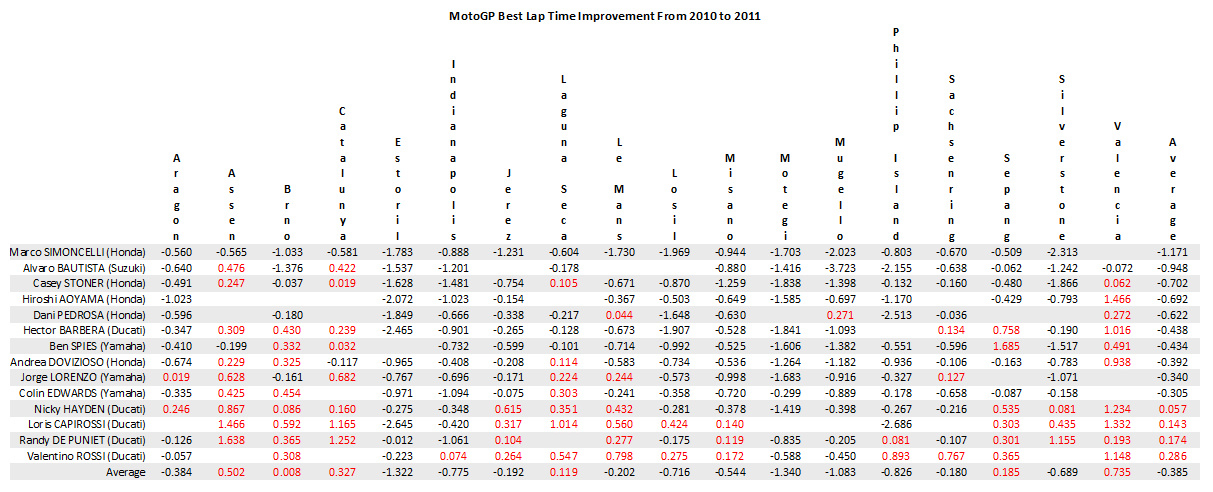
Click on chart for larger version.
With these safe harbor statements out of the way, the most improved rider from 2010 to 2011 was the late Marco Simoncelli. Simoncelli went faster in every event in 2011 except, of course, the final race at Valencia, held two weeks after his fatal accident in Malaysia. On average, the tall Italian’s best lap times dropped 1.171 seconds from 2010 to 2011. Simoncelli rode a Honda RC212V both years, though with an advantage of a factory-spec bike in 2011 equipped with the enviable seamless gearbox. Still, some credit is due to Simoncelli’s fearless attack of the race track.
The second most improved rider was Suzuki’s Alvaro Bautista. There were only two races where he did not improve on from 2010, Assen and Catalunya, but these were events where most riders did not improve. On average, Bautista’s best lap times were 0.948 seconds better in 2011, with huge improvements at Mugello (3.723!) and Phillip Island (2.155!). Too bad Suzuki decided to stop funding the team just as they were figuring out how to be competitive again.
The third most improved rider was the new world champion, Casey Stoner. Stoner’s best lap times on the Honda were 0.702 seconds better, on average, than his best lap times on the Ducati in 2010.
Hiroshi Aoyama and Dani Pedrosa were the fourth and fifth most improved riders, though both missed a number of events in either 2010, 2011, or both.
Hector Barbera was the only Ducati rider to improve, on average, from 2010 to 2011.
The situation at Ducati was as bad in the numbers as they looked on the track. All the riders that failed to improve, on average, were on Ducatis in 2011.
The best of the worst was Nicky Hayden. His best lap times were 0.057 seconds slower, on average, in 2011. Hayden probably would have had better results if he had stuck with the 2010 or 2009 Ducati MotoGP bikes.
The worst of the worst was – no shock here – Hayden’s teammate, Valentino Rossi. Rossi’s best lap times were, on average, 0.286 higher in 2011. One wonders what the number would have been if Rossi had not raced injured in 2010 (injured shoulder, broken leg, etc.).
Rossi, of course, was hired by Ducati to get the job done that Casey Stoner failed to do with enough regularity; that is, win lots of races and championships as Ducati does in World Superbike racing. So let’s take a look at Stoner’s best lap times in 2010, on the Ducati, to Rossi’s best lap times in 2011.
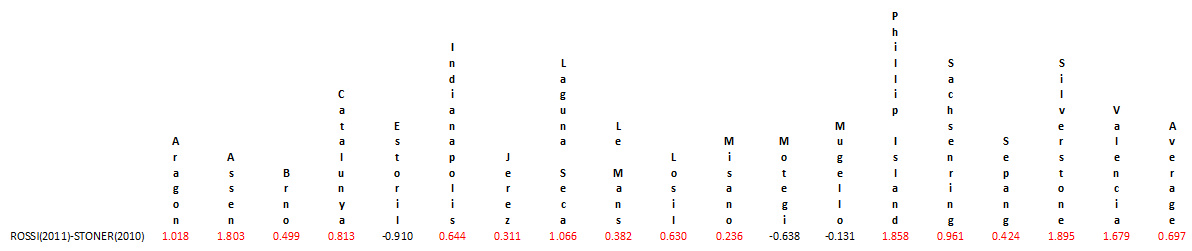
Rossi-Stoner comparison. Click chart for larger version. (Chart by Tracy Hagen)
On average, Rossi’s are a huge 0.697 seconds worse than Stoner’s.
Ducati took a huge backward step in 2011. The 2012 pre-season tests do not suggest that either Hayden or Rossi will be leading any of the early races. Indeed, even with the extra 200cc of engine capacity, Rossi’s best lap time at the first Sepang test was two minutes, 0.824 seconds. Stoner went 2:01.408 in 2009 in the warm-up practice ahead of the race. At the second Sepang test Rossi’s best lap time was 2:01.550.
At the recent Jerez test Rossi’s best time was 1:39.733. Stoner’s best Jerez time in 2010 was 1:39.511 and in 2009 it was 1:39.415.
I’m willing to bet that there will be at least one race in 2012 where Rossi will fail to lap the 1000cc Ducati as fast as Stoner went on the old 800cc Ducati. Any takers?
 Rider Files