Over the years gathering notes and interviews has changed a great deal. I first started reporting races for Cycle News in the early 1980s. Very early on I covered only local races, knew most of the racers personally and rarely took notes when talking to the riders after the races. As I grew as a journalist and began covering a wider variety of events, sometimes outside my realm of expertise, I found in order to jot notes and take quotes I started using reporters’ notebooks.
As my wife will attest, I rarely throw anything out that I think may have some historical relevance in the future. Housed in several boxes, deep in the back of a closet, I still have all of the notebooks I took down notes and quotes in those early years. Whether or not anyone (even me) could ever go back and decipher what those notes say is another matter.
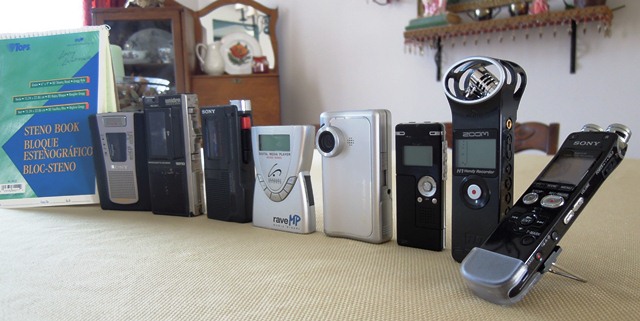
The tools of gathering interviews has changed dramatically over the years.
Sometimes I would conduct long feature interviews with nothing but my notebook. Oh how I wish I had recordings of some of those interviews!
Fortunately sometime in the mid-1980s I started using tape recorders for interviews and notes. For a time I used both a notepad and recorder. Eventually I simply used the tape recorders as an electronic notepad.
Again I think I’m very fortunate, and I guess I should give myself a little pat on the back, for having the forethought to hang on to all those old tapes. I know a lot of reporters who would stick a tape in their machine, write their stories and then recorder over the previous race at the next event. I didn’t do that. I kept the tapes and used new tapes for each race. It cost a lot more and those tapes quickly stacked up, but today I have a vast archive of hours of taped interviews going back 30 years.
You name them I have them on tape. All the stars of motocross, road racing, flat track and even the occasional hillclimber, speedway and off-road stars from the mid-1980s till today. I’ve gradually been going through and digitizing that collection. At some point I plan to feature some of these old interviews on this website.
I started with micro-cassettes. I used those for years and they were OK, but the sound quality was never great and the tapes didn’t hold up as well. Finally I started using Sony’s excellent portable full-size cassette recorders. The sound quality was much better and the tapes more durable.
Then in the late 1990s MP3 players first came on the market. I was delighted to find that many models had built-in mics and allowed you to voice record. I was an early adaptor to digital audio voice recording. Unfortunately, like the sound quality of some of those early digital devices was actually a step backwards from cassette tapes.
Throughout the 2000s digital audio recorders got ever smaller with better sound. Things have gotten increasingly complex. In the old days you stuck a cassette in the recorder and hit the red record button. At the most you might have a high and low sensitivity switch for the built-in mic. My latest recorder came with a 147-page manual!
I would encourage you to go out and buy a digital recorder interview your local heroes and ask them about their lives and careers. You’ll never know how valuable something as simple as being able to hear a voice and a person’s thoughts and remembrances years later can be. It could be a great gift to future generations.
 Rider Files
Great read…and good for you! I’ve kept my audio recordings as well, though most of mine were conducted with racers long after their careers had wrapped up. Your writing has inspired me to make sure they are still safe…somewhere!
LikeLike
Kent,
Good job! Get them converted to digital files.
Larry
LikeLike