By Larry Lawrence
A story I did a few years ago for Cycle News.
I remember it like it was yesterday – 1982 and Cycle News East editor Gary Van Voorhis stood outside of Road America’s turn five with Nikon FM camera in hand. As other photographers in the area fidgeted (including me) and looked down to make sure they had the right settings on their cameras, Gary stood there talking casually to me as the AMA Formula One took the green flag and roared to life maybe 300 meters up the hill from us. A minute later Eddie Lawson, Wes Cooley, Steve Wise and the rest of the pack zoomed into view braking heavily for the downhill left-hander. You could hear nearby photographer’s camera motor drives clicking off dozens of frames. Not Gary. Instead of burning a roll of film with a heavy shutter finger, he waited for the perfect moment, had his focus point and composition set and just when the pack was in the perfect position he lightly pressed the shutter button, just once.
Being a rookie racing photographer at the time I looked up and laughed – “Gary, you took just one shot!”
“Don’t worry. I got the shot,” he smiled proudly. “I’m shooting this entire weekend with two rolls of Tri-X.”
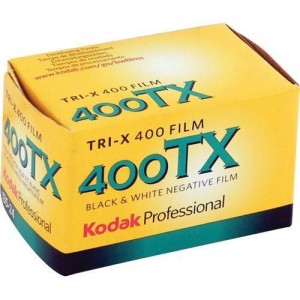
Kodak Trix-X was the standard film for race coverage from the 1960s through the '80s. Not everyone could shoot an entire road race national with two rolls like Cycle News editor Gan Van Voorhis was famous for doing.
I couldn’t believe it. Gary was shooting for both East and West editions of Cycle News (thus the two rolls of film). He would photograph the Formula One, Superbike, 250 Grand Prix and Battle of the Twins races with two 36-exposure rolls of the classic Kodak black & white film. In addition to action shots Gary was famous for getting excellent personality portraits of riders talking to one another or to their crew members, girlfriends, fans, and the like. So in two days Gary would pack the photographic story of an entire AMA national weekend into just 72 frames. Today’s digital photographers will burn 72 frames in a single practice session.
Sure enough a week or so later when my Cycle News arrived there was Gary’s turn five photo from Elkhart Lake on the cover. Just as he had promised, he’d gotten the perfect shot of nearly the entire Formula One field battling to haul their bikes down from triple digit speed on the downhill slope, heading into the tricky turn. Not only had Van Voorhis shot the entire race weekend with two rolls of film, he also had to hoof it around the facility to get interviews with the racers and crews. Gary was a one-man crew for Cycle News that year. He was photographing the races and writing the race coverage as well.
As hard as it is to believe now, in those days if you didn’t actually attend the nationals, the first you would find out the results was when Cycle News came to your mailbox a week and a half or two after the event. The glossies like Cycle, Cycle World, Motorcyclist and Cycle Guide even did race coverage of the bigger races in those days for those who didn’t get Cycle News. So in reality a lot of people’s first knowledge of an AMA Grand National, an outdoor motocross national, an AMA Supercross or AMA road race national came months later in one of the glossies!
The speed at which you get the news from the races is the biggest change I’ve witnessed in my 30-plus years of being a motorcycle racing reporter. We take for granted that the internet and live TV have made today’s race coverage instantaneous. The technology has made race coverage a lot speedier, but it also demands more of those reporting on the races.
In pre-internet days reporters and photographers would pretty much leave the track as soon as the racing was over. A reporter would generally only use quotes from the podium finishers so a post-race walk through the paddock was icing on the cake and would really only be necessary if one of the big-name riders had experienced problems. Reporters and photographers would then go out to a decent restaurant or bar and have dinner at a civilized time then get back to the hotel, and if they were ambitious, start typing up their story on a typewriter to be faxed the next day. Photographers would often get to an airport to drop off film to go on an airline to California (or Atlanta) to be picked up and processed the next day. For the glossies the slides would be sent out for processing and sent via Fed EX or UPS a couple of days after the race. It was a pretty relaxed pace.
Today if you walk into a media center after a race you’ll see writers and photographers alike toiling like crazy over their laptops. The quest now is to be the first to post on various websites or news outlets. And they may spend three or four hours in the press room after the races and eventually leave a dark and lonely track in search of any place that’s open. More often than not it’s fast food.
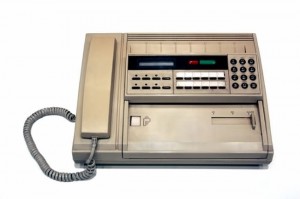
Fax machines were the way to get the story on deadline. If one wasn't available you might have to transcribe your story to someone on the phone.
When I first came into race reporting in the early 1980s, ink pen, notepads, portable typewriters and fax machines were state of the art. Photography was primarily done on black & white film, because color was rarely used (never in the case of Cycle News in those days).
Paul Carruthers, who came to Cycle News in the early 1980s, said things were a bit more basic during that era.
“We didn’t have live TV and modern timing and scoring, so you’d go somewhere where you could see the most of the track,” he says. “You had a stop watch and you would take your own lap chart and keep track of the gaps and take occasional lap times. In some ways it was better compared to today. Now you cover it like almost everyone else from the TV monitors and you only see what they’re showing you.
“You might have used a micro-cassette recorder for quotes, but more likely you’d just take notes. Today everyone digitally records everything and you spend hours during the course of a weekend transcribing press conferences.”
Getting the typed pages and photos to Cycle News in those day could be a real adventure. When Henny Ray Abrams was living in Belgium and covering the GPs, he would often go to an airport, park, walk in and find a gate for a flight that was going to Atlanta and offer a total stranger 10 or 20 bucks if they would carry an envelope with story and film to Atlanta, where a Cycle News staffer would meet them at the gate to pick up the stuff on arrival.
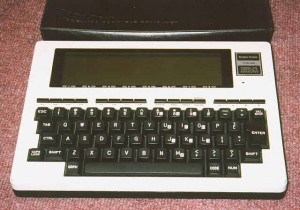
We'd hook up these little Radio Shack computers to an acoustic phone coupler to send the story.
At the office the staff would build the paper column by column on paste-ups. Typed pages would come in, the editors would go over them and make corrections the margins in red ink, then hand the sheets off to typesetters. Photos would come in and be made into to half-tones and pasted up as well and the paper would take shape.
When computers first began showing up at the races by the mid-1980s they were these little Radio Shack TRS-80 computers that would run for two or three days on four ‘AA’ batteries.
“The big thing then was you could transmit your story over the phone,” Carruthers remembers. “But you had to get the settings just right on the computer and you’d do a count down to someone at the office to get the computers to talk to one another at the same time. It was a little bit of a hassle, but it saved a lot of time.”
Later in the 1980s quick results could be had on the internet with text-only services like CompuServe and Prodigy, but very few people were online.
I remember going nuts trying to send out race reports to outlets like the Associated Press, USA Today and various local newspapers, each with their own unique computer systems that you had to spend 15 minutes on the phone with their computer experts to get the settings (like baud rate, parity, stops bits, xmodem or ymodem) and the pre and post-text codes that had to be used in sending stories and results.
In 1994 a fellow journalist and road racer named Brent Plummer called me and told me he’d launched Motorcycle.com on the World Wide Web. Even though I was fairly computer literate, I had no idea what the World Wide Web was and I had to go to my local college, which had Mosaic browsers, to be able to see what he was talking about. There I saw a website for the first time. Little did I know almost 20 years ago how the Web would totally change the world forever.
 Rider Files
Holy crap you’re old, Larry….
LikeLike
Hey, I was in the lead when that photo would have been taken. I want the photo!!! Hahaha.
LikeLike
I hear ya Kevin. Mark, I bet Gary V still has those negs somewhere.
LikeLike
Those old days were a challenge for sure getting results,it was a delight getting AMA results from CN in the 70’s,a painful wait but a delight.To get GP results had me using an shortwave radio to get few bits of news off the BBC and then I had to get a portable SW for when I was on the road away from home.Life is very good now.
LikeLike
Wow, so with the shortwave you had results before anyone else. Awesome. I remember when Kevin Schwantz won in Japan in ’88 John Ulrich called me. I didn’t believe him. That was amazing for him to go over and win his first race in his first full year of GP.
LikeLike
Larry…….BBC aired only very brief results,the best to hope for was top three and usually only the 500cc class and the report was over in 15 seconds,maybe a little longer if Sheene won and that was after listening to five minutes of soccer scores.Bottom line was BBC didn’t always give any bike results.
LikeLike