By Larry Lawrence
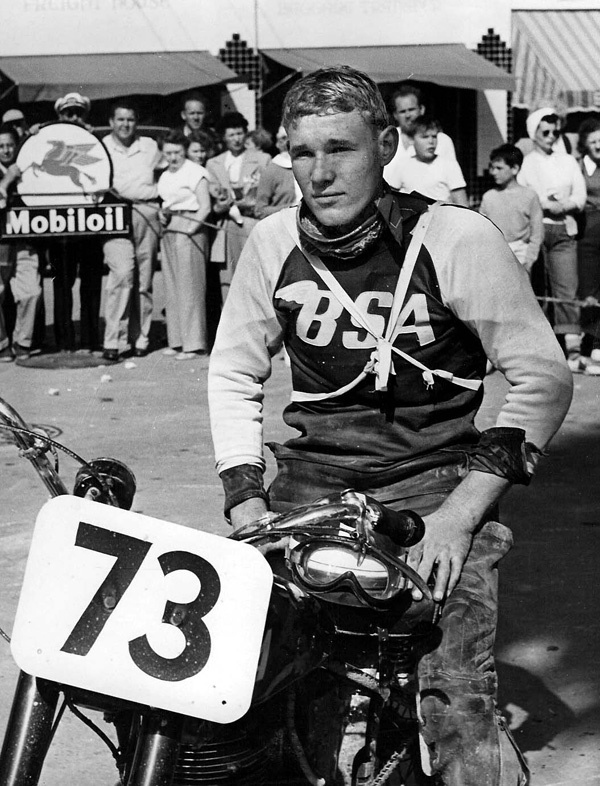
Feets Minert won the popular Catalina Grand Prix in 1956 and was a leading rider before the days of specialization.
‘Feets’ Minert still remembers the day he got his nickname. Still a scrawny teenager, Minert walked into the LeBard & Underwood Motorcycle Shop on Firestone Blvd, in Los Angeles. Minert, who at the time stood only about 5 feet, 8 inches, wasn’t an imposing figure, in fact there was nothing particularly big about him except one thing – his feet. For some reason this skinny, short kid was born with a pair of size 12s. His logger boots only magnified Minert’s disproportionate dogs. Shop co-owner Jim Underwood walked in, took one look at the kid, and exclaimed, “My God, look at those feet!”
Feet morphed into Feets and a nickname was born for one of Southern California’s best off-road motorcycle racers of the 1950s.
Feets Minert (real name Chuck) first got into motorcycles the hard way, by washing them. An older buddy in Minert’s LA neighborhood had a Harley that he liked to keep clean. The only problem was that he didn’t necessarily like the work it took to keep his pride and joy nice and shiny, but he found the solution in Minert. Minert gladly accepted the role of weekly bike washer, and he did it free of charge. The reward for his labor was a short ride around the block ride of the Harley after the wash to make sure it was totally dry.
Those Saturday morning rides whetted the young Minert’s appetite for motorcycles and LeBard & Underwood became Minert’s hangout. Lucky for Feets the shop’s co-owner Aub LeBard was a legendary off-road racer who won the prestigious Big Bear Enduro three consecutive times. LeBard was taken by Minert’s enthusiasm and he helped the youngster along in his path to racing.
“Aub really taught me most of what I know about racing,” Minert said. “I got into the Orange County Motorcycle Club and we would go out on weekend trail rides and I followed Aub and try to copy what he was doing on the bike. He was about the hottest trail rider in Southern California at the time. It was a great learning experience.”
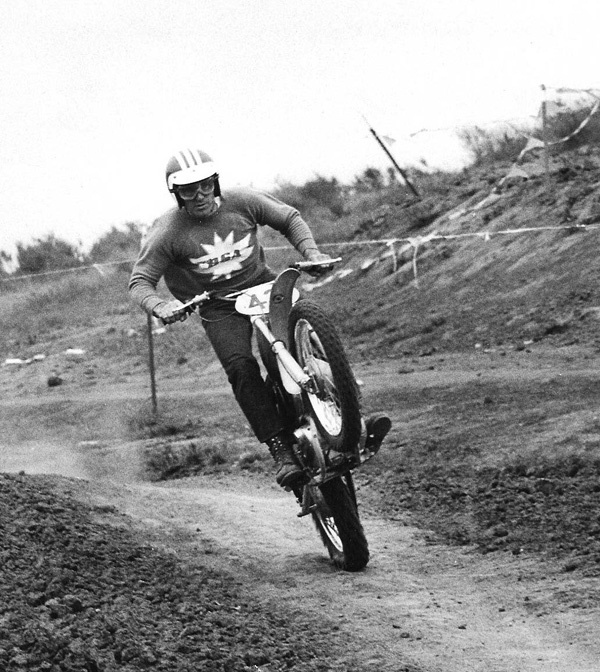
Minert was one of the early stars of American motocross racing in the 1960s.
By the late 1940s Minert began winning races in Southern California. He raced it all – enduros, scrambles, flat track, TT and trials. Louie Thomas BSA offered him a ride for the amateur event at Daytona in 1950. Minert had never ridden anything like the old beach course. He proved to be a quick study and turned in a solid performance in the race finishing fourth.
One of the biggest races on the West Coast during this era was the Catalina Grand Prix held on Santa Catalina Island about 20 miles off the coast from Los Angeles. The event attracted hundreds of racers, including many of the AMA Grand National stars of the day. Racing motorcycles were shipped over on packed barges at midnight when the seas were calm in preparation for the weekend’s race.
Minert finished second in the 1951 Catalina Grand Prix and was pegged to be the next West Coast factory BSA rider when he was called to serve in the Navy during the Korean Conflict.
While stationed in Japan, Minert had his BSA Gold Star shipped over to participate in Japanese scrambles races. “This was the early 1950s and the Japanese riders had never seen a bike like the BSA,” Minert remembers. “They wouldn’t let me race it. Too big I guess. But they loaned me a little pressed-steel-framed Honda. It was a lot of fun.”
After the service Minert turned his attention again to Catalina. The Grand Prix was held on a 10-mile racecourse starting and ending in the town of Avalon. It consisted of paved roads, fire trails, single track and even utilized part of a golf course. BSA fitted a special five gallon tank on Minert’s Gold Star so he wouldn’t have to make a pit stop during the 100-mile final. 199 entries were in the race and Minert got off to a relatively incident-free start. Everything was going according to plan when Minert slid in a turn and went down, bending his right handlebar at a sharp angle.
“I thought the race was over for me at that point,” Minert said. “I could ride, but nowhere near the pace I could before the crash.”
The lucky break of the race for Minert came in the form of burly Triumph dealer Louie Thomas. Minert pulled into the pits and Thomas grabbed the handlebar and with all his might gave it a tremendous pull. “He got it almost completely straight,” Minert recalled.
With repair made Minert was quickly back underway and passing other competitors at torrid pace.
“I knew things were going well late in the race when I was getting thumbs up from the pit crew when I came by,” Minert said. “I had no idea though that I had gotten into the lead.”
Minert took the checkered flag in the closest finish of the Catalina GP. Walt Axthelm and C.H. Wheat were second and third on BSAs, making it a clean sweep for the British maker. The top three were separated by just 50 seconds.
BSA heavily advertised Minert’s Catalina victory and he reached a new level of recognition.
Minert stayed with BSA through the 1960s as American scrambles evolved into full-blown motocross.
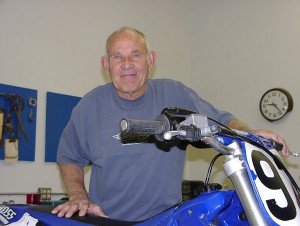
Minert in 2002. (Larry Lawrence photo)
When the Trans-AMA started in 1970 the British brought over the factory team that featured Dave Bickers, Dave Nicoll, Jeff Smith and Arthur Lampkin. Minert and David Aldana made up the American factory squad. Already the European and Japanese two-strokes were making the four-stroke BSA obsolete, but Minert stuck to the brand to the bitter end.
Minert, who was in his 40s by the early 1970s, was a regular points scorer in Trans-AMA races. Eventually the big four stokes were no longer competitive and Minert faded from the pro racing scene.
He never quit racing though and now in his 70s the ever-fit Minert is a top competitor in vet races. He very well may hold the title for the rider who has competed in the most races. He lost count after 2500 races six or seven years ago. He also took up flying and pilots his plane right out of his hanger/garage in an airport community southeast of Los Angeles.
Minert’s name will forever be linked to the British BSA maker. He says brand meant something during his days of racing.
“I was a BSA guy then and still am,” Feets says with a laugh. “To this day I never fully trust a guy riding a Triumph.”
 Rider Files
A SoCal District 37 legend. I saw him race at Perris, amazing rider.
Devon Sowell
LikeLike