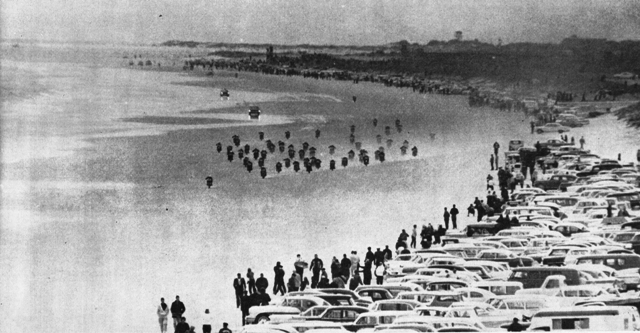
When the Daytona 200 was held on the beach the crowds were huge, but hard to control.
Tradition is a hard thing to overcome. In the late 1950s the grand old Daytona 200 was in trouble. Change was in the salty sea air, but the AMA was resisting. Moving the 200 from the beach to the newly-built Daytona International Speedway was sacrilege to the sport’s leadership. The Daytona 200 was, and always had been a beach race and if the racing establishment had anything to do with was going to remain so.
The problem was valuable beachfront property. Development along the Daytona Beach was reaching farther and farther south every year. The original beach course of 3.2 miles incorporated a north turn that nearly came up to Daytona Beach’s Main Street. After World War II a new 4.1-mile course was opened south of town near Ponce Inlet. But by the late 1950s even the once desolate south course was also being overrun by residential and commercial development. Sand dunes, palmetto and cabbage palm were replaced by aquamarine colored hotels and seaside bungalows.
Another major issue was crowd control. In 1953 veteran racer Cliff “Red” Farwell and a spectator died after Farwell hit the spectator crossing the road during the race. Policing the long stretches of lonely beach road was a major challenge. Organizers actually brought in National Guard troops at one point in the mid-1950s to keep spectators off the road.
The old beach road was starting to show its age as well and as any rider of the era will tell you the beach road surface was anything but straight and smooth. Faster riders actually got airborne in sections with speeds reaching into the 130 mph range. Some riders resorted to installing hooks on their bikes that would keep them in their saddles while speeding down the undulating road.
“You’d be going down the backstretch and it was wavy,” said two-time Daytona 200 winner Joe Leonard. “You’d hit that wave in the road at about 130 mph and it would knock the breath out of you. Then you’re run onto the beach was dependent on the tide. You didn’t want to be behind someone. They’d hit you with the spray from the ocean water and it would blind you with the goggles we had back in those days.”
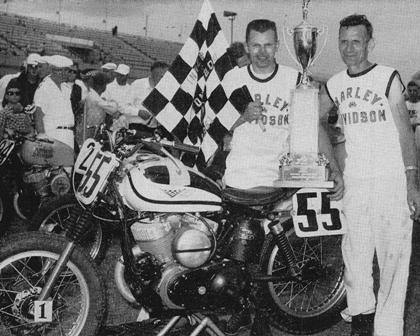
Roger Reiman won the first Daytona 200 at Daytona International Speedway 50 years ago. His victory was seen by a sparse crowd.
Finally, insurance costs and the sanitary facilities needed for 15,000 fans combined with all the other challenges made the beach race an all but impossible task. The late Bill Tuthill, who owned Daytona’s Museum of Speed, pegged the cost of putting on the race in 1959 at $45,000 (nearly $318,000 in today’s dollars).
It got so bad that after the 1958 race, won by Leonard, rumors circulated that the event was the final chapter on the race once known as the Handlebar Derby. Fans and racers alike didn’t know until relatively late that the 1959 race was on. A last-minute resolution with real estate developers had been reached and the 200 would see another green flag – at least for one more year.
The 1959 and 1960 races went on at the beach, the latter being promoted by West Coast promoter J.C Agajanian, but by now Bill France had completed construction of the expansive Daytona International Speedway. France wanted the Daytona 200 to move to his new track, but the AMA competition committee had serious reservations about motorcycles running on the 33-degree banking. About a month before the 1961 race an agreement was reached and the 200 would move to the Speedway, but would run on a two-mile infield road course that did not utilize the banking. It would be another three years before the competition committee felt that motorcycle brake, frame and tire technology had advanced enough to run the high banks and in 1964 the full 3.81-mile road course, including the banking, was used for the first time.
Fans stayed away in droves in the early races at the Speedway. The sights, sounds and smells of the old beach course were hard to beat. In addition to the thousands of fans who paid to watch the race, hundreds more anchored boats just offshore and watched for free while fishing and drinking beer. Also the challenges presented to the rider on the beach were formidable. After hitting 130 mph heading south on the bumpy asphalt road, the riders would charge into the soft and rutted south turn, trying to slow there bikes down with outmatched brakes. Then they would dial on the power and skit the edge of the Atlantic Ocean. Some even went into the water creating a steamy rooster tail rising up from the back wheel.
At the Speedway the bikes looked tiny viewing the infield road course from the grandstands. Plus racing speeds were well down on the tighter track as compared to what were reached on the old course.
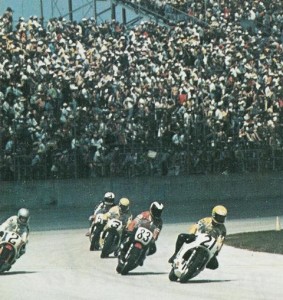
When the European GP stars starting coming to the Daytona 200 in the early 1970s the crowds came back in droves.
News reports of the day generously reported a crowd of 7,500 spectators at the first Daytona 200 held at the Speedway in 1961, less than half the typical attendance at the beach. It wouldn’t be until the heyday of the 200 in the 1970s, when world champion riders like Agostini and Sheene competed that the attendance would match or surpass that of the 1950s.
Interestingly the riders who won the last race at the beach and the first race at the Speedway had a great deal in common. Brad Andres won the 1960 race on the beach. Roger Reiman won the first race at the Speedway in 1961. Both were sons of motorcycle dealers, both cut their teeth racing TT courses, rode for Harley-Davidson and Reiman later matched Andres’ three Daytona 200 victories.
“A lot of riders hated racing on the sand,” Leonard recalls. “I’d say a little over half of them were in favor of moving over to the Speedway, but with the fans that was a different story. Nothing blocked the view and people could get right up next to the track with bikes zipping by on the beach and it was pretty spectacular for them.”
While traditionalist called the classic beach course the real Daytona, the fact is the race was held on the beach a total of 19 times. At this year’s Daytona 200 it will mark the 50th anniversary of the 200 at Daytona International Speedway.
 Rider Files