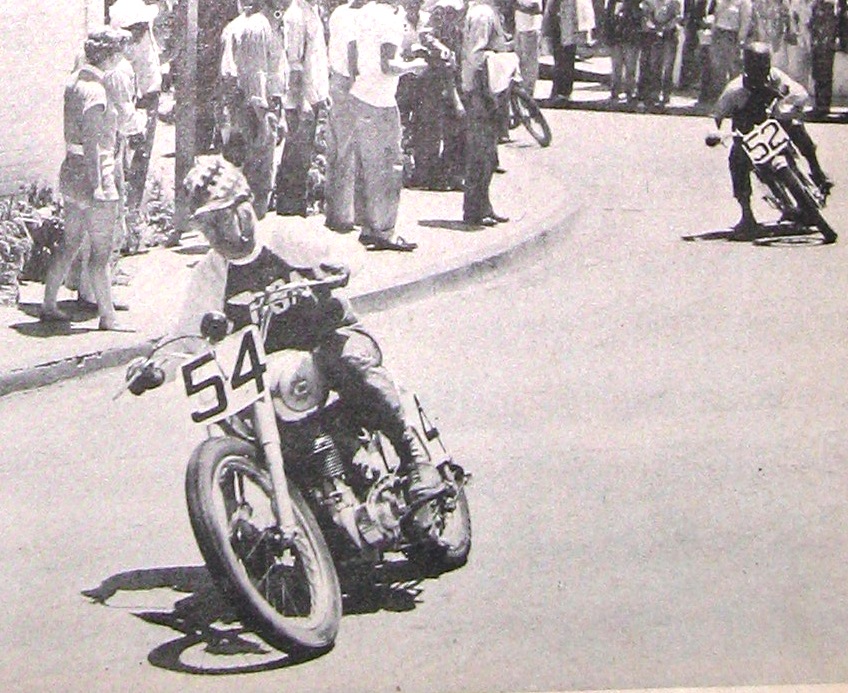
Nicholson was one of the stars of the Catalina Grand Prix in the 1950s. Here he runs his BSA through the downtown section of the course.
You be hard pressed to find a rider in motorcycling that matched the sportsmanship shown by Nick Nicholson. Nicholson was the leading off-road racer of the West Coast in the 1950s who was best known for his victories in famous the Catalina Grand Prix. Nicholson was known not only for being blazingly fast – Dick Mann once called him one of the best overall riders he’d ever known – but Nicholson was also perhaps the most unselfish rider who ever threw a leg over a motorcycle.
Fellow competitors grew to greatly admire Nicholson, not for his race wins, but for his reputation for stopping on the trail and offering assistance anytime he saw another racer in trouble.
Checkers Motorcycle Club co-founder Don Brown once recalled at the Ram’s Run National Championship Hare ‘n Hound in 1952, he was running near the front with a group that included John McLaughlin (who ultimately won the overall), Al Rogers, Del Kuhn, Bud Ekins, Butsy Mueller and Nicholson. On a fast downhill section Brown ran off the trail and ultimately launched himself and his Matchless off the edge of an 18-foot cliff.
Nicholson overshot the same corner, but managed to avoid the cliff. He looked down the gulch and saw the crashed Brown.
“I was down there lying on my back side,” Brown recalled in a 1994 letter to Cycle News. “Nick negotiated his way down to where I crashed. He calmly leaned his BSA against the hillside and brought over some tools and bailing wire. With minor assistance from me, with a big rock he proceeded to methodically beat my front wheel into a bumpy, but generally round shape. Then he wired the spokes that were loose and tightened others and trued the wheel the best he could and tightened the bike’s axle.”
All the while Brown kept reminding Nick that he was in the front group and losing valuable time. “He simply smiled, finished the work, picked up his bike and was off chasing the leaders. I’m not sure I could have shown such regard for a fellow rider in the same situation.”
Such was the talent of and affection by the racing community for Nicholson, that Cycle Magazine coordinated a fundraiser to help pay the expenses so that Nicholson could compete in the most famous motorcycle race in the world – the Isle of Man TT. While the magazine raised a good portion of the cost, it didn’t reach its goal. Nicholson didn’t want to disappoint all those who’d donated to the trip so he and his wife Alice sold nearly everything they had to fill the gap for the overseas trip.
In preparation for racing the ’53 Isle of Man, Nicholson competed in continental circus road races in Belgium and Germany. He and Alice arrived at the Isle of Man a few weeks before the race so he could study the island road course, which covers everyday roads and is a little over 37 miles long. BSA supplied the couple with a road bike and Nicholson would ride the course while Alice, sitting behind him, wrote notes that her husband could later study. At other times, Alice would take the controls of the motorcycle so Nicholson could study the course more closely.
In the Senior TT, Nicholson was running securely in silver medal time when he came upon a multi-bike accident that ultimately claimed the life of former TT winner Les Graham. Nicholson unselfishly stopped to see if he could offer any assistance and then got back on the course and rode opposite race direction to warn course marshals of the crash. Even while participating in the race of his dreams Nick put others first.
The stop cost him positions in the race, but he still managed to finish 18th, earning a bronze medal. Les Graham’s home club later awarded Nicholson a special plaque for his sportsmanship and he was lauded as a hero by the British motorcycling press. The ever modest Nicholson reluctantly accepted the praised heaped upon him.
“Maybe the era he was born in made him the man he was,” said journalist Maureen Lee. “Whatever the case, we don’t seem to be raising anymore, or at least not many, people like Nick.”
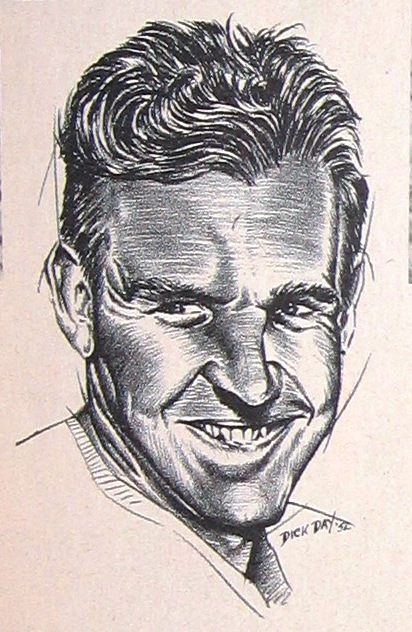
Nick Nicholson
After the TT, Nicholson stayed in England the rest of the summer. He worked in the BSA plant and rode a variety of scrambles (motocross) and trials competitions. Upon returning from England, Nicholson opened a motorcycle shop in Long Beach.
Nicholson was a motorcycle racer period. It didn’t matter what kind of race it was, if it was on two wheels Nicholson was involved. He competed and won in everything from trials to enduros, hillclimbs to motocross and even road racing. In 1953, Nicholson won the 100-mile support race to the Daytona 200 on the old beach course. He was the gold standard to which riders on the West Coast in the early 1950s compared themselves. “I remember when I finally beat Nick Nicholson,” said another Hall of Famer Bill Brokaw. “I felt like I had the world by the tail.”
A hard crash at an AMA national at Willow Springs took Nicholson out of action for a couple of years, put he continued to trail ride for the rest of his life.
Nicholson was on the leading edge during the introduction of motocross to America in the mid-to-late 1960s. He housed and sponsored riders from Europe and as a Greeves Motorcycle dealer he backed many of the early stars of off-road and motocross racing, including riders such as Malcolm Smith, Gary Bailey, Preston Petty and Jim Rice, to name a few. Russ Darnell’s first job was working as a gofer/parts washer and later mechanic at Nicholson’s shop.
In 1965, Nicholson returned to the Isle of Man to race in the ISDE for the American team. He was 41 years old at the time. Even after Nicholson retired and sold his dealership, he never slowed down with his involvement in motorcycling. He moved to Lake Isabella, about 200 miles north of Los Angeles. He explored all the local trails and formed a new motorcycle club. He continued to sponsor motorcycle events and also competed in American Historic Racing Motorcycle Association events. Nick and Alice raised two children, Keith and Kathy.
Nicholson died in 1994 at the age of 70. Just months before, during his birthday, Nick went for a casual trail ride with his son. When the pair rounded a bend they were met by dozens of Nick’s old trail riding buddies. It was a birthday surprise set up by Nick’s family. At dinner that night there was another surprise when Nick was greeted by over 100 friends who’d shown up for his birthday. “We finally got one over on the old fox,” one of his buddies said of the surprise party.
That’s the kind of loyalty Nick Nicholson engendered.
“I always remembered that gesture of Nick helping me on the trail that day,” Don Brown said. “He was certainly an all-round great rider, but maybe even more importantly he was an ambassador of goodwill for motorcycling wherever he went.”
 Rider Files