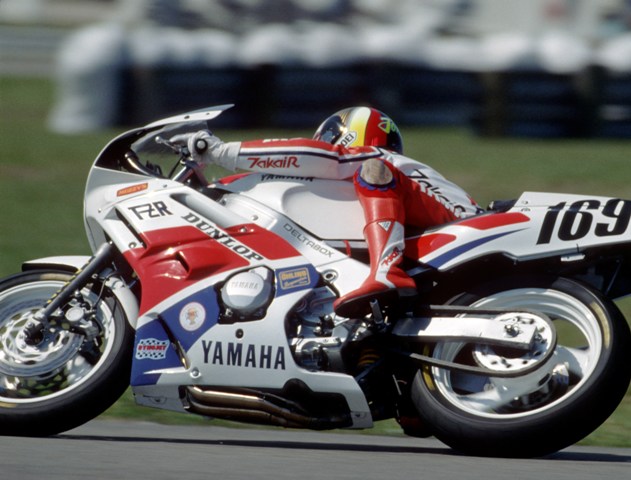
John Kocinski, who’d gone the 250GP racing route, missed out on production racing phenomenon of the 1980s, in which rider skill was all important. This was finally his opportunity to show just how good of a rider he was on equal, or near equal machinery to his fellow competitors. (Larry Lawrence photo)
Honda found out early that winning AMA Supersport races sold motorcycles. AMA road racing’s return to production rules in 1988 with Supersport did a couple of things – it immediately made privateers competitive against the factory teams and it put pressure on the manufacturers to make their sport bikes much more racetrack capable.
Another thing Supersport racing did was prove that the top dog on the track was going to be the leader in the showroom as well. Honda sold a ton of Honda Hurricanes on the strength of sweeping every single AMA Supersport race in 1987. In fact, for all intents and purposes the ’87 series was a spec class. No rider other than Honda-mounted scored a single championship point the entire year.
Suzuki jumped into the fray and won the Supersport title in 1988 with Yoshimura and Doug Polen, helping Suzuki gain a foothold in the 600cc sport category, even though the Honda was still the superior machine with privateers like Mike Smith, Gary Goodfellow, Paul Bray and David Deveau winning on the CBR600 Hurricane that season.
In 1989 Yamaha introduced its answer to Supersport racing in the FZR600. It was an upgrade from the air-cooled FZ600. Yamaha was looking to make a big splash in the 1989 Daytona Supersport race. The company’s entry marked a clear escalation in the Supersport wars. Now three of the four Japanese manufacturers were involved in the class. Kawasaki would follow suit a year later.
Yamaha came to Daytona loaded. Never before had a factory showed so much interest in a production class race. Once on the track it was clear that the new FZR 600 was clearly superior to the other machines competing in the Supersport class. To top that off, Yamaha procured the services of four of the finest racers in the country, Floridians Thomas Stevens, John Ashmead, Georgian Cam Roos and Cal Rayborn III, son of the legendary road racer of the 1970s. That quartet was a clear choice for the team. Stevens, Rayborn and Ashmead had won Supersport races before, and Roos was the top Yamaha club racing contingency money winner in 1988. Rob Muzzy and crew were also contracted to prep and provide race service, one of the few times the legendary tuner was linked with Yamaha.
While Stevens, Ashmead, Rayborn and Roos made a formidable team, Yamaha was still worried what Honda might do. It was rumored that Honda was slated to bring down Canadian-spec CBRs that were faster than the U.S. version and fit through a loophole in the AMA Supersport rulebook.
Yamaha’s ace in the hole was John Kocinski.
The choice of Kocinski was at the same time, brilliant and puzzling. To get Kocinski to ride the FZR would almost insure Yamaha the win. Even if someone showed up with a faster machine (the Canadian model Honda CBR 600, which turned out to be close but not quite as fast as the Yamaha) Kocinski would out ride them. But getting Kocinski on a production bike seemed somehow out of place. After all, this was the same John Kocinski who publicly has adopted his boss’s, Kenny Roberts attitude towards racing “streetbikes”. When asked about racing on the FZR, Kocinski took the safe company line of “I race what they (Yamaha) tell me,” while having a tone that would indicate that he really wasn’t pleased about it. But this facade of, I’ll do it because they tell me to but I really don’t enjoy it, didn’t hold up under close observation.
The fact was Kocinski truly enjoyed racing the FZR and looked forward to showing what he could do on a production based machine. Much of the attention during the late 1980s was focused on factory-backed production contingency racing, and Kocinski, who’d gone the 250GP racing route, missed out on production racing phenomenon in which rider skill was all important.
This was finally Kocinski’s opportunity to show just how good of a rider he was on equal, or near equal machinery.
The qualifying heat races were run in misty and cold conditions on Thursday of Bike Week. Cal Rayborn III won the first heat, coming from behind to pass Canadian Superbike champ Rueben McMurter on a Canadian Honda. Scott Russell was supposed to race a Yoshimura Katana 600, but after seeing the speed of the Yamahas, Suzuki pulled Russell’s entry, claiming that he wanted to concentrate on the 200. Russell’s Suzuki went to the rider who would go on to become the all-time Supersport King, Canadian Miguel Duhamel who could only muster a 12th-place finish in the final on the underpowered Suzuki.
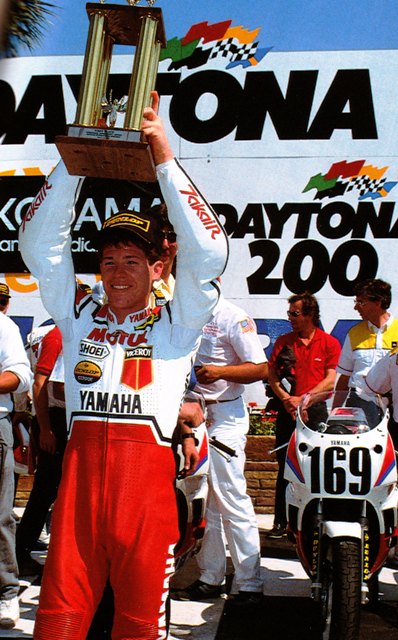
Kocinski was panelized for jumping the start in his Heat race so had to plow through the massive Daytona 600 Supersport field to take the victory in his first of only two career appearances in the series. (Courtesy DIS)
Kocinski easily won the second heat, but was penalized for jumping the start. “One guy on the grid was telling me to move forward, another guy was screaming for me to go back. They didn’t know what the hell was going on.” claimed an irate Kocinski after the heat race.
Stevens inherited the heat win, followed by Jeff Farmer and Jamie James.
With Kocinski starting at the back of the huge grid, many riders felt a lot better about their chances. After qualifying Stevens had a big grin on his face. “I don’t know how John is going to get through the field very quickly. It’s like a 125 B class motocross race out there with all the bumping going on. I plan to be long gone by the time he gets through that mess.” Kocinski himself was concerned about the situation. “The fast guys are going to be so far ahead by the time I get up past the pack, it will be tough to get in a position to win this thing.” said Kocinski.
Yoshimura Suzuki rider Jamie James jumped into the lead early but was doomed when his Katana hit the high-banks and was gobbled up by the horsepower advantage of the FZR’s. “I was losing 10 to 15 bike lengths on the banking. There was nothing I could do but watch em’ pull away from me,” said a disgusted James.
Stevens took over the lead and started pulling away from the rest of the field. Kocinski meanwhile, got a great start and was slicing his way well up into the first wave of riders by the end of the first lap. Kocinski’s charge through the field was an amazing thing to see. In Turn One he looked to be at least 10 mph faster than anyone else, flicking his FZR over and drifting both wheels to the edge of the racing surface before hitting the gas and shooting out of the turn like a rocket. In three laps Kocinski had passed 51 riders and was closing rapidly on Stevens.
A lap later Kocinski swept by Stevens on the outside going around the west horseshoe and was gone. The pass that Kocinski put on Stevens was almost scary. Here was Stevens, one of the best Supersport riders in the country, and Kocinski went around him so fast it looked otherworldly. Stevens wasn’t about to give up. He tried in vain to pursue but ended up crashing in the process. “I thought that since we were on the same bikes I could pitch it in the turn as fast as he (Kocinski) was. Next thing I know, I’m sliding on my back trying to figure out what I did wrong.” said a puzzled Stevens who was unhurt.
Once Stevens was down, Kocinski was unchallenged. A good battle for second took place between Nick Ienatsch (on assignment from Motorcyclist Magazine), Roos, Jeff Farmer and Rayborn. In the closing laps Kocinski continued to pull away. “I never like to see how far ahead of my competition I am, I just like to ride my race.” said Kocinski, explaining at the time why he didn’t slow down once he was in to the lead. Farmer was having a great race, and with two laps to go pulled solidly into second.
Kocinski crossed the finish line 13.6-seconds ahead of Farmer.
Yamaha’s entry into Supersport was a remarkable success. Nine of the top-10 finishers at Daytona that day were on Yamahas and the maker won every race that year, as well as the championship with Scott Zampach.
The Supersport arms race was already in place, but Yamaha’s entry in 1989 marked a distinct escalation of the battle between manufacturers in the class that continues today.
 Rider Files
An excellent article on a fascinating race. One critical omission was the guiding hand of Rob Muzzy.
Yamaha contracted Muzzy to prepare and manage the FZ600’s for their Daytona debut.
Probably the only time the Muzzy magic was used by Yamaha.
LikeLike
Doug, I’d either forgotten or didn’t know about the Muzzy connection. Thanks for adding that tasty bit of info.
That’s what I love about comment section. So much more content and context can be added to a story.
Larry
LikeLike
However, according to the rule book at the time Kozinski should have been disqualified from the race due to using an illegal seat cowl (clearly in place in your photo). The rule book specifically stated they were illegal for use even though they were a Yamaha accessory.
I had the battle of ages with the AMA/CCS race director at the time due to his disqualifying the top 3 or 4 racers at a CCS event at Blackhawk Farms because they used the seat cowl. This was at the first Midwest region CCS event of ’89 shortly after Daytona. Both rule books (AMA and AMA/CCS) read the same on this.
LikeLike
Gordon,
That’s interesting. I wonder how many riders used the cowls that year? If Kocinski had been DQ’d Jeff Farmer would have won that race.
LikeLike
I believe the rule was changed later in the season. Seems so many people were using them Roger Edmondson gave in and relented on the rule. There was no performance advantage in using them and the rule never did make sense to me.
LikeLike
Kocinski may have been a strange one, but such an amazing rider. The first race I ever watched was a 24 hour race at Nelsons Ledges. He was racing a GSXR750 for I believe Cycle Tech. He was 16 and so small he had trouble getting on the bike. But he was so obviously better than the other riders that I could see it, with no experience watching racing! That race got me hooked on road racing.
LikeLike
Another thing not mentioned in the article was Kocinski’s appearance in the Daytona Supersport race started a trend of manufacturers bringing in top guns to race Daytona only.
LikeLike
Dave Deveau’s 1989 600 Supersport win was on the Wheelsmith racing / Factory Pro cbr600.
It was the green ‘Heineken Special’ – the result of a beer distributor not being able to put up their share a week before the Sears national. We went into the grocery store and stole some Heineken marketing materials and bought a 6 pack. Cut out the H emblems and glued them on the tank + a shot of clear lacquer. The carburetion was an early Factory Pro Supersport jet kit and it had one of our first handmade ignition advancers that revved 500 rpm higher than stock.
We had raced a Katana 600 all through the year and only rode the Honda once.
Dave was part of the Mark McDaniel Odenkirchen, Joe Brett Willians, Jim Williams Racing late 80’s / early 90’s norcal spoiler group.
Jim Williams Racing raced an fzr400 and a Katana 600 in WERA Endurance, often running lead lap in the top 5 on ‘the little bikes’.
LikeLike