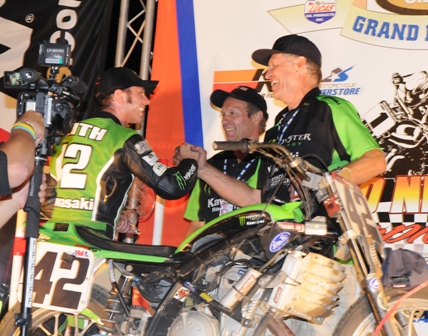
The three men most responsible for Kawasaki's first AMA Grand National Twins victory at the Indy Mile - rider Bryan Smith, R&D tester Jay Springsteen and builder Bill Werner, here pictured atop the Indy Mile podium. (Larry Lawrence photo)
MotoGP and the tragic events of this past weekend somewhat overshadowed an incredibly important milestone in the history of AMA Grand National racing on Saturday night. Bryan Smith rode a Kawasaki Ninja 650-based flat track bike to victory in the AMA Grand National on the famed Indy Mile, marking the first time a Kawasaki won a Grand National Twins race.
To be clear this isn’t Kawasaki’s first Grand National victory. Yvon DuHamel gave Team Green that honor way back in 1971 when he won the AMA National road race at Talladega on a Kawasaki H1R 500cc two-stroke triple. Nor was it the first Grand National flat track win for Kawasaki. That honor went to Henry Wiles when he won the Springfield (Ill.) TT in May of 2008 on a Kawasaki KX450F. Smith’s victory was the first for Kawasaki against the dominant Harley-Davidson XR750 in a Twins races, or in other words on a Mile of Half-Mile AMA Grand National race.
The history of Kawasaki on the big Grand National dirt tracks is fairly limited. Erv Kanamoto built Kawasaki H2-based flat trackers in the mid-1970s. Scott Brelsford scored the first AMA National points on Kanamoto’s Kawasaki Triple on the Albany (N.Y.) Mile on Sept. 29, 1974. Kawasaki reached its high point in 1970s Grand National flat track competition at the San Jose Mile on Sept. 21, 1975. In that race two of Kanamoto’s bikes made the national. Scott Brelsford scored ninth, ultimately the best result of the Kawasaki Triple on the dirt ovals. Don Castro also qualified at San Jose on one of the H2s and was 15th.
Castro remembers racing the H2. “The things had so much power that the problem was the back tire,” he said. “It would just spin and chew up the rear tire, but once it hooked up we were probably hitting 140 mph on the straights. It was a blast to ride.”
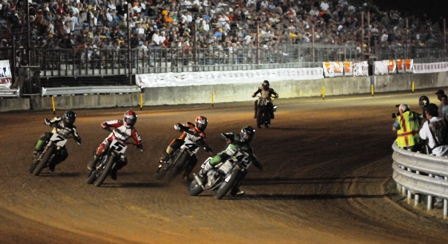
Bryan Smith on the No. 42 Kawasaki leading in the Dash for Cash at Indy. (Larry Lawrence photo)
Castro went on to say that Goodyear was developing a bigger rear tire that would have allowed the two-strokes to hook up. “Had the AMA not banned those bikes I’m sure within a year or two the Grand Nationals would have been nothing but 750cc two-strokes. The tire technology was coming and there’s no way the Harleys could have run with those two strokes.”
With the banning of the two-stroke road race motors Kawasaki was out of Grand National Twins racing for over 30 years.
The now defunct Basic Expert Twins class inspired legendary Harley-Davidson tuner Bill Werner to build a relatively low-cost Kawasaki flat tracker. That machine became the basis for the Monster Energy Kawasaki Grand National entry. In 2009 the bike just missed making the main with Brock Schwarzenbacher. For this season the team signed one of the elite riders in Bryan Smith and suddenly the Kawasaki has been a consistent contender, culminating with the victory on the Indy Mile.
In interviewing Werner earlier in the season at the Gas City (Ind.) Short Track National, he talked about the difference in cost between his Kawasaki and a typical Grand National bike.
Werner 1
Even though Werner’s Monster Energy Kawasaki was relatively inexpensive, is it a fair comparison to what a typical customer Kawasaki could be compared to the hours of R&D Werner, Jay Springsteen and Bryan Smith have done with the bike?
Werner 2
Could Werner make a kit Kawasaki customer bike?
Werner 3
Werner on what he’d like his legacy in the sport to be.
Werner 4
Werner’s opinion on the long held notion that parallel twins couldn’t be made competitive in flat track racing.
Werner 5
 Rider Files
Very cool to see them get this under their belt with the work put into this effort.
Also way cool to hear this interview again after being there when you talked to him originally back in June. The man is so laid back and so knowledgeable, I could never get bored listening to him. Let alone such a nice guy.
Very cool Double L–leading edge again my man!
LikeLike
Great post, answered a lot of questions concerning Kawasaki in US racing. And the Bill Werner interviews are awesome (but too short!).
LikeLike
Just read this from Joe Kopp’s race report and had to add it:
“As we go down the back stretch, here comes Smith on that Kawi, as he blasts by me going into turn three. We both hammer through turn three and four and as we go down the front stretch I pull up and try to draft back by him. As I pulled up along side him, he took back off! Dang, I thought my Duc was fast, but that Kawi is way faster! So I was not able to draft back by him, but at the same time I felt pretty good”
LikeLike
Way to go Bill. A great interview. “The truth be known”……..
The good part is Bill is doing something good for the sport, guess what a lot of people will hate him for it. I don’t and all the people that do not have a dog in the fight love him for it.
I am sure the pressure is on to stiffle his efforts and the success of the Kaw program. I do not see how those efforts could succeed with Bill at the helm and as tight as he is with AMA.
We need that class C effort in this sport- that is what attracts the average fan. An easy and cheap way to enter into competition. Maybe it will not be outlawed.
LikeLike
John
I agree with you. I would love to see the manufacturers offer flat track bikes that could be bought in dealerships somewhere under 10 grand. And no DTX is not the answer.
LikeLike