What in the hell happened to Supermoto? It seemed like just yesterday when the old AMA Pro Racing (the one actually owned by the AMA, not the new DMG version) held a press conference at Daytona International Speedway announcing the launch of the AMA Supermoto Championship. The series had good buzz for a few years and before you knew it was gone, off the radar of just about every motorcycle website save for the Supermoto sanctioning body itself and maybe Cycle News.
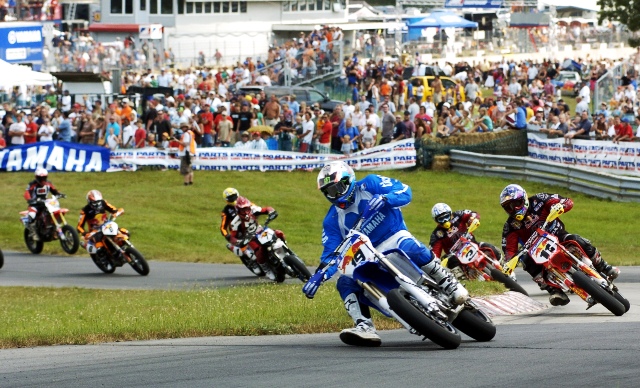
Doug Henry leads before a big crowd at a 2005 AMA Supermoto event in Waterford, Mich. (Larry Lawrence photo)
The series has practically disappeared and probably only gets any support these days because of its inclusion in the X-Games.
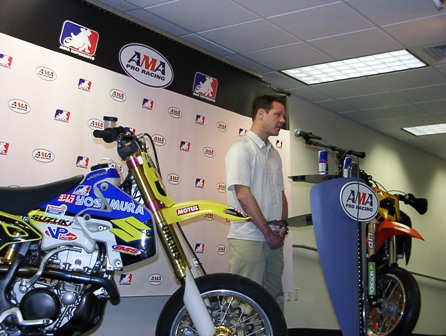
Andy Leisner announces the formation of the AMA Supermoto Championship in 2003 at Daytona. (Larry Lawrence photo)
Quick… anyone know who won the most recent round of what is now called the XTRM AMA Supermoto Championship in Las Vegas? Do you think you could even attempt to answer that without doing a web search, where it still may take some time to find? The answer by the way is Derek Costella. No offense, but I’d never heard of Derek and I follow motorcycle racing about as closely as anyone.
It’s not Derek’s fault that no one knows who he is of course, that’s the job of the sanctioning body and the promoters to make stars out of these riders, but frankly Supermoto may be too far gone to make a star out of anyone.
I talked to Andy Leisner not long ago to ask him his thoughts on the downfall of the series. Leisner was a Vice President at AMA Pro Racing and was largely responsible for the exciting launch of AMA Supermoto in 2003. Leisner cited the lack of sponsorship (Red Bull was series sponsor in the early years and did a ton of promotion for the series), non-existent TV package and the lack of an energetic and hard-working point person to manage the series.
“Chris Bradley and a fair number of support staff spent almost all their time working on Supermoto in those early days,” Leisner said. “Chris was young, enthusiastic and just plowed forward and made things happen. I mean he was setting up races in the middle of downtown in places like Columbus (Ohio), Dallas, Las Vegas and Reno. Can you imagine the red tape he had to deal with to get those races coordinated? It was a tremendous undertaking and after Chris left the AMA no one ever really stepped in and had the passion and the energy to work the series like he did.”
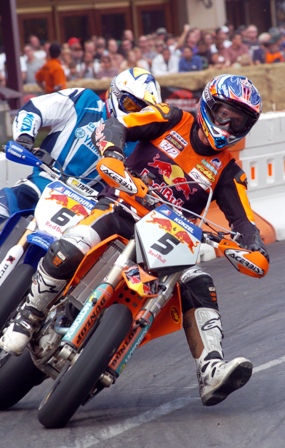
The biggest crowd ever to watch a Supermoto race was at Reno in 2005. Here Jurgen Kunzel and Mark Burkhart battle in that event. Note the crowd in the background. (Larry Lawrence photo)
In addition Leisner agreed that the more technical the tracks got – with large dirt and man-made jumps – the less it attracted road racers and flat trackers to compete against motocross racers who were used to going large on jumps. So the early days of having Kevin Schwantz, Aaron Yates, Ben Bostrom, Joe Kopp, Nicky Hayden, Jake Johnson and other top road racers and flat trackers going up against motocross racers like Jeff Ward, Kurt Nicoll, Doug Henry and Mark Burkhart quickly went by the wayside.
Also in the early days of Supermoto, big-name riders like Doug Chandler, Jeremy McGrath, Travis Pastrana regularly raced the series. Those riders attract fans and media attention no matter what they race, that wasn’t the case when the series matured. Within a year or two Supermoto specialists like Mark Burkhart, Ben Carlson and Jurgen Kunzel emerged and got so good that the McGraths, Pastranas and Chandlers of the world could no longer be expected to win. And as good as they were fans had a tough time warming up to the new generation of Supermoto stars.
A big blow came when the sport lost one of its two premier riders (Jeff Ward being the other) when Doug Henry was paralyzed in a regional event. Then Carey Hart’s younger brother, Anthony Hart, died in a Supermoto practice session in Connecticut. Suddenly the lax safety measures of the sport were exposed and the fun series suddenly turned a lot more serious.
Finally the venues that were successful went away because of the complications involved running them. The biggest crowd ever to see an AMA Supermoto race was certainly at the AMA Red Bull Supermoto-A-Go-Go in Reno in October of 2005. Police estimated the crowd at 40,000. The catch was no one paid to see the race since it was free. Nevertheless the Reno race marked a high-water mark for AMA Supermoto and provided a template for how the series should proceed.
Supermoto in America is not dead, but it’s on life support. Somehow the current promoter needs to figure a way to parlay the popularity of the X-Games and take the series back to the streets of cities and towns summer and fall events. If the fans get to watch for free, so what? They’ll buy tons from concessions and it will provide added value to any municipality’s annual festival and sponsors.
I saw photos from the most recent round in Las Vegas and it made me sad. There were no fans. Let’s hope the series can be revived someday. It still has the potential to get everyone excited like they were back during the origin of the sport in the 1970s when the ABC Wide World of Sports Superbikers first hit TV screens, and like they were when the series was re-launched as a national championship in 2003.
 Rider Files