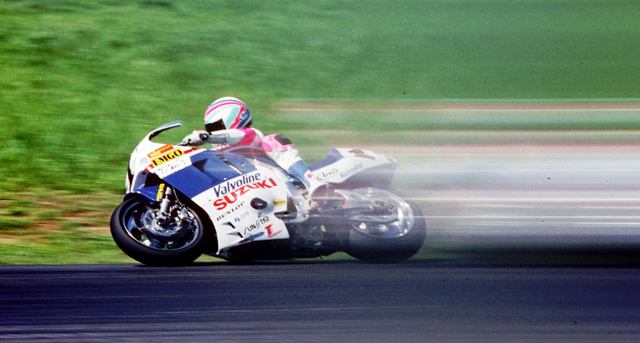
Kurt Hall at "Super Speed" (Larry Lawrence photo, although I'm ashamed to admit it)
I just had to laugh when I came across this photo of Kurt Hall on the Valvoline Suzuki Endurance machine. Speed filters were all the rage in photography during the mid-1980s. They were the photo equivalent of mullet. They only looked cool for about one week and then they were completely and hopelessly out of style.
Essentially what you had was a filter on the front of your camera lens that added streaks of lights to one side of the image to give the impression that the subject was rushing by at “Super Speed”, thus the name.
I used this crazy filter for one weekend. After seeing the images I decided it would be best to leave the good ol’ “Super Speed” in the camera bag.
 Rider Files
Well, I won the 1983 Best Sports Stories competition (put on by The Sporting News) using the Ambico Action Maker the first time I used it. Road & Track magazine ran two of my photos using the filter in the September 1982 issue on their coverage of the 1982 Detroit GP Formula 1 race. The results never looked as good as that first time I used it. I started the wave of photographers using this filter and I ended it too.
Here’s a scan of the original layout in R&T . . .
And here’s the cover of Best Sports Stories 1983 . . .
The filter worked well enough to top every magazine (including SI) and newspaper in the USA.
LikeLiked by 1 person
Jay,
So you were the guy! Did you wear a mullet too?
But seriously…
Whoa! Now that’s a little bit better application of the super speed filter than my photo. Your shots actually make me want to give it another try. Great stuff. Thanks for sharing.
Larry
LikeLike
And a little more info regarding such a rotten filter . . .
Dale Kistemaker organized an exhibit of Formula 1 photography back in 1984 and Ford paid for a run of 400 catalogs of the photos of the exhibit entitled “Passion and Precision: The Photographer and Grand Prix Racing 1894-1984” and my R&T shot was good enough to grace the cover to represent the modern era of GP photography. It was overlaid on the famous Lartigue photo with the oval wheels, and the French were very upset that Dale disfugured the photo with mine. Too bad . . .
Here’s a scan of the full Kodachrome (not a good scan but so what) from the catalog, along with a scan of the cover and the forward of the catalog . . .
LikeLike
I had this habit of using lenses and stuff that today everyone ridicules, but I had to do my photography on the cheap so I used what tools I had to their best advantage.
I used the Nikkor 500mm F8 Reflex mirror lens to get the top spot in Road & Track for Formula 1 the first time I approched them to see if they’d even be interested in my photos (by a complete unknown) and this was the result . . .
And today my 20mm F3.5 non-AI Nikkor is looked on as trash, but again it paid dividends for me . . .
LikeLike
The real key to the use of the streaker filter (which I still have) was the background situation. Thre reason my first use worked well was that I shot it from above with asphalt and the one guardrail as my background, and the guardrail (Armco) does not looked streaked nor does the ground (pretty much anyway), just the car. Also, the exposure on K64 was 1/60th at F5.6. Ambico recommended a wider f-stop. I had a double page spread of three streaker shots in the Grand Prix International coverage of the 1982 Las Vegas F1 GP, which I hated but everyone else loved (just like the R&T shots, which were the only pictures I ever had published where I got fan mail on the shots).
Since you and your site is road-racing bikes, here’s a bit of trivia about my shot in R&T. It was damp out and there was only one person at the corner with me. The guy asked about what I was doing with the filter so I let him check it out by letting him actually look through the camera. The guy was Denis Jenkinson, F1 correspondent for the British magazine Motorsport, and Denis was the side-hack world champion in 1949 including hanging his tail out many times at the Nurburgring. Denis is most famous for starting pace notes in Rallys when he was the navigator for Stirling Moss when they won the Mille Miglia in 1955 in the Mercedes 300 SLR . . .
“After the war Jenkinson started competing on two and four wheels, but he lacked the funds to race regularly. He found that acting as sidecar passenger to top riders enabled him to both enjoy top-level European competition himself while being paid and to scratch a living writing about it – he was passenger to Eric Oliver (with whom he became World Champion in 1949) and Marcel Masuy.
Jenks abandoned front-line competition to become Continental Correspondent for Motor Sport. He spent his summers touring Europe and his winters in a succession of ‘digs’ in England; Jenks eventually settled near Crondall in Hampshire in a tiny run-down house with no mains electricity or water, largely full of his archives and of parts of vehicles he was ‘fettling’. He was legendary in the sport for the lack of basic domestic amenities in his home; to Jenks nothing mattered but racing. He became accepted as the ‘elder statesman’ of British racing journalists due to his closeness to the teams and drivers, his conversational writing style and his obvious and enduring passion for the sport.
DSJ loved to race and drive Porsche cars and coined the term wischening (pronounced as if in German) for the manner in which one may corner successfully in a Porsche 356.[1] He later adopted an E-Type Jaguar as his work transport, although at home he had assorted decrepit vehicles including an elderly Mercedes-Benz saloon, a Citroën 2CV and others. He remained a motorcycle enthusiast, and competed in hillclimbs and sprints on his own Triumph-BSA hybrid well into his seventies.
His most famous competitive outing though was as navigator for Stirling Moss during the 1955 Mille Miglia; his article on this With Moss In The Mille Miglia is generally recognised as a classic of motor racing journalism. His book The Racing Driver was based on his experience as navigator and is a true classic worthy of any motorsports literature collection. His “pacenotes” while on this event was pioneering, leading up to today’s use of pacenotes in rallying.”
The above is from Denis’ page at Wikipedia . . .
http://en.wikipedia.org/wiki/Denis_Jenkinson
LikeLike